Spiritual projects of Gelephu Mindfulness City
From BhutanWiki, the people's encyclopedia of Bhutan · culture · Verified
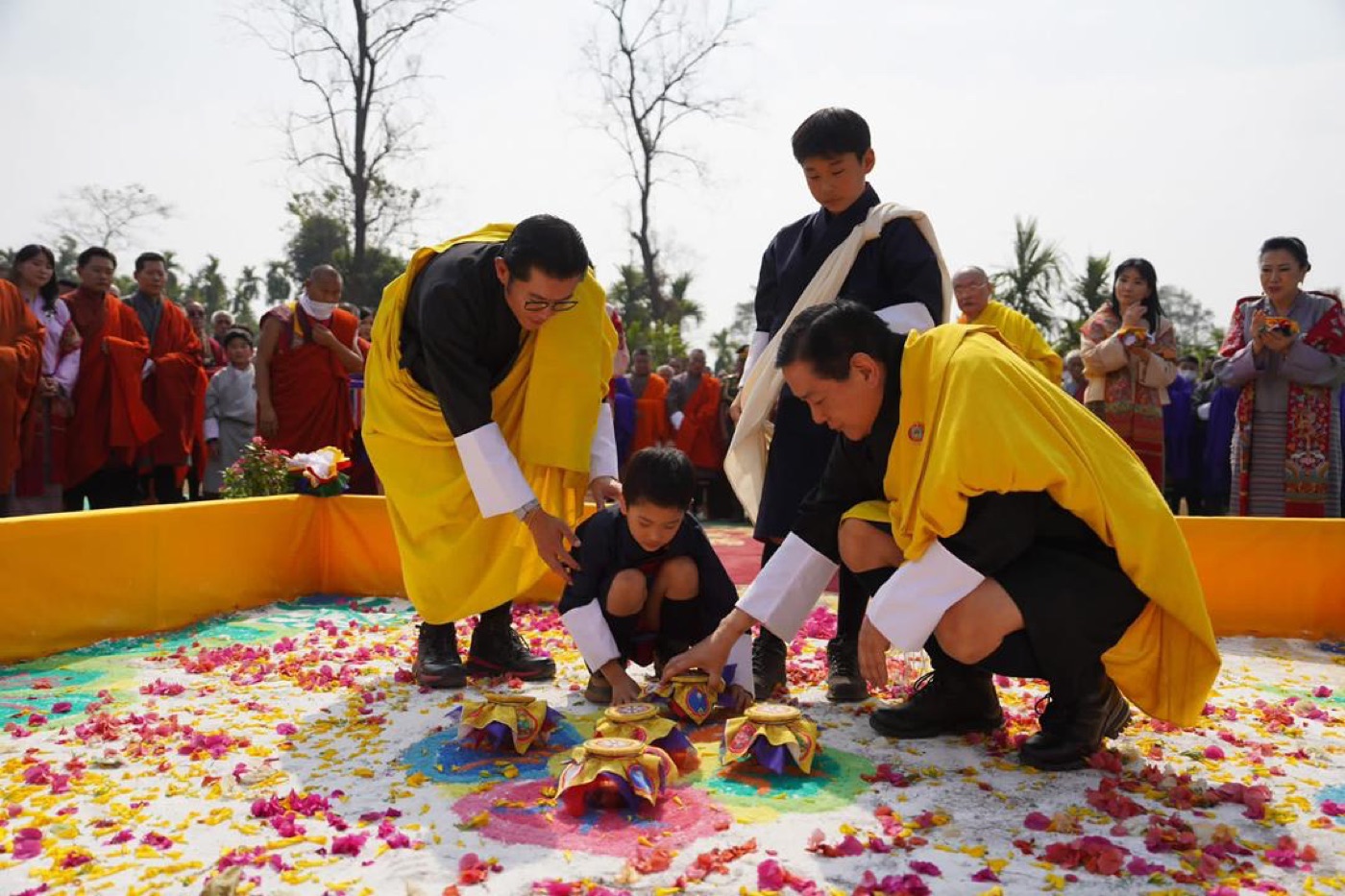
Gelephu Mindfulness City (GMC), the special administrative region planned along the India–Bhutan border in Sarpang, includes a large religious building programme alongside its commercial and infrastructure components. The Gelephu Mindfulness City Administration (GMCA) has described the religious dimension of the project as an attempt to establish a centre for Vajrayana Buddhism "of unprecedented scale in Buddhist history", drawing on the involvement of senior Bhutanese and Himalayan spiritual masters. The stated aim is for GMC to serve as a global hub for Buddhist pilgrimage and practice, linked to the wider network of sacred sites across the region.
The programme is organised as a network of officially approved "sacred sites". Each is authorised by a Royal Edict, or kasho, granted by King Jigme Khesar Namgyel Wangchuck. By mid-2026 the number of approved sacred sites had reached 22. They range from large stupas and temple campuses to healing gardens, retreat centres and a long-distance pilgrimage trail. Construction has relied heavily on the zhabtog tradition of voluntary communal labour, with successive volunteer phases drawing tens of thousands of participants.
The most visible milestones so far are the consecration of the Ugyen Norlha Chorten and the groundbreaking of the much larger Gelephu Chorten, both marked on 21 February 2026, the King's 46th birthday. A separate undertaking, Project 108, plans to raise 108 stupas in a single day on 1 November 2026.
The sacred-site programme
GMC's religious masterplan treats sacred construction as integral to the city rather than as ornament. Projects are proposed by monastic institutions, foundations and individual lamas, then submitted to the GMCA and, if approved, granted a Royal Kasho. The Central Monastic Body (Zhung Dratshang) is involved both as a proponent of specific projects and in consecration ceremonies.
An early batch of eight projects received Royal Kashos on 12 May 2025 at Simtokha Dzong, among them a Vajrayana training and exhibition centre proposed by the Central Monastic Body, the Kangyur Labyrinth proposed by the Drikung Kyabgon, and several stupa and mandala complexes.[1] The Ugyen Norlha Chorten and the Gelephu Chorten are designated Royal Projects within the same network.
The eight Royal Kasho projects of 2026
On 1 May 2026, at a ceremony at Simtokha Dzong, the King granted Royal Kashos to a further eight spiritual projects, bringing the total number of approved sacred sites to 22.[2] The eight, with their proponents, are:
- Dewachen Spiritual Centre — the Tsugla Lopen of the Central Monastic Body
- Druk Yoga and Mindfulness Centre — Gyalwa Dokhampa
- Jampal Gyepai Dangden — the Karma Leksheyling Foundation
- Kathok Zhithro Kilkhor — Kathok Situ Rinpoche
- Menjong Healing Garden with Medicinal Buddha — Neyphug Trulku
- Peling Dzogchen Lingka — Sungtrul Rinpoche
- Tendrel Nyensel Healing Centre — Chung Tulku
- Varahi Mandala — Khandro Dorji Phagmo, reported as the first GMC sacred project led by a female spiritual leader
Reported features across the eight include a stupa of roughly 200 feet, a three-dimensional mandala representing the bardo (the intermediate state between death and rebirth), and a campus modelled on the Pure Land of the Buddha Amitabha, alongside healing gardens, retreat space and a contemplative leadership centre.[2]
Gelephu Chorten
The Gelephu Chorten is the largest single structure in the programme. Its groundbreaking took place on 21 February 2026 at Chuzergang during celebrations of the King's 46th birthday. Three generations of the royal family — the King, the Fourth Druk Gyalpo Jigme Singye Wangchuck's generation, and the young Gyalsey — together with the Je Khenpo broke ground for the structure.[3]
The chorten is to rise about 80 metres, a height presented as symbolising the 80 years of the Buddha's life. Its design follows the Jarung Khashor Chorten in Nepal, better known as the Boudhanath Stupa in the Kathmandu Valley; Bhutan's first king, Ugyen Wangchuck, had sponsored a major reconstruction of that stupa in the early 20th century.[4] The groundbreaking coincided with the fifth GMC volunteer (zhabtog) phase, in which press reports counted well over 12,000 participants across the city's sites.[5]
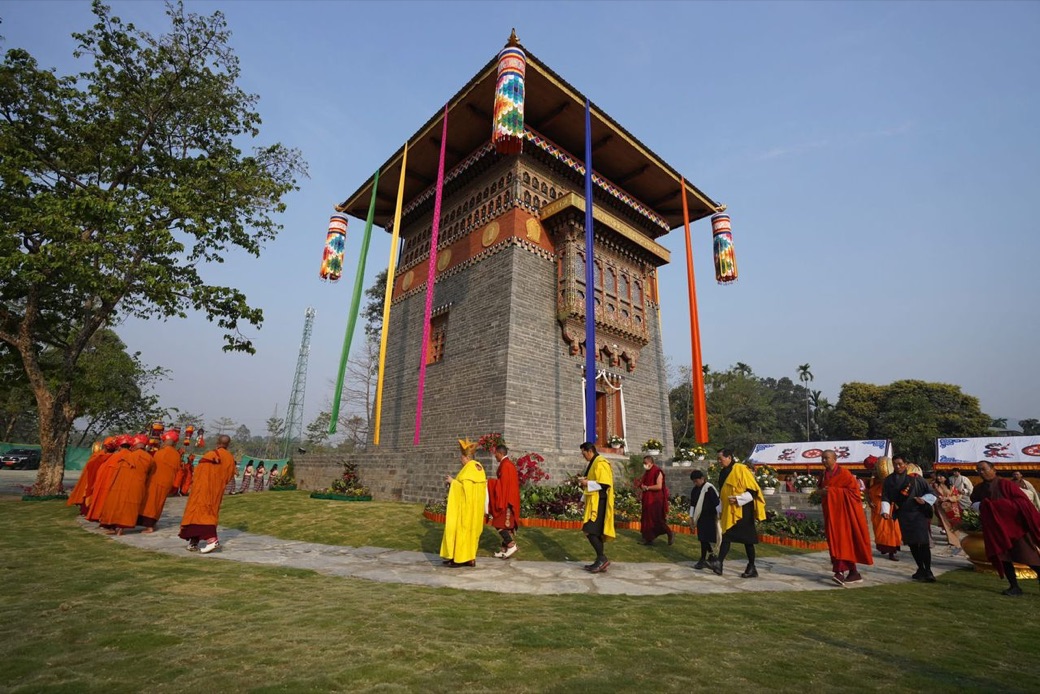
Ugyen Norlha Chorten
The Ugyen Norlha Chorten was the first sacred structure completed within GMC. It was consecrated (the rabney ceremony) on 21 February 2026, the same day as the Gelephu Chorten groundbreaking. The chorten enshrines Ugyen Norlha, a prosperity manifestation associated with Guru Rinpoche (Padmasambhava), the eighth-century master credited with bringing Vajrayana Buddhism to Bhutan.[6] It stands near the main entry to Gelephu from India and is intended to greet visitors arriving at the border.
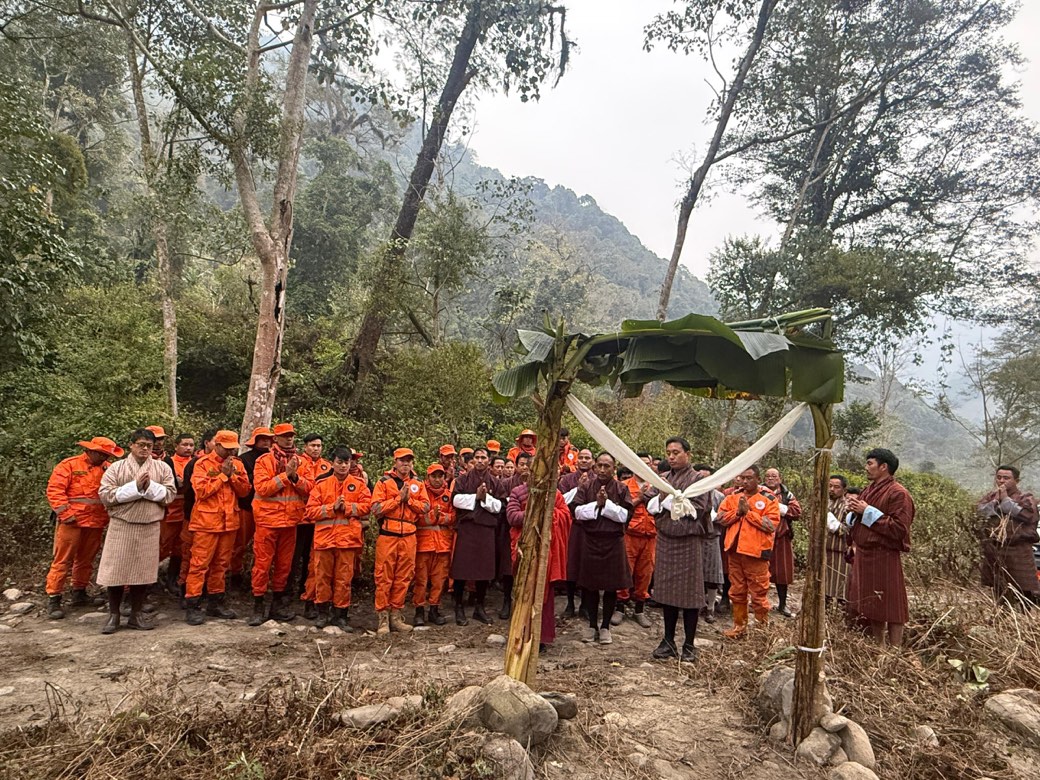
The Lotus-Born Trail
The Lotus-Born Trail is a long-distance pilgrimage route tracing the legendary journey of Guru Rinpoche, who according to tradition entered Bhutan through the southern plains of present-day Gelephu and travelled north to Kurjey Lhakhang in Bumthang at the invitation of King Sindhu Raja. The route is reported to run roughly 167 kilometres over about eight days, climbing from subtropical forest near the border to alpine ridges in central Bhutan.[7] Construction was launched during GMC's fourth volunteer phase, with work beginning on a segment between Ritay and Jigmeling, and the project is being developed in stages by reopening older, partly disused paths.
Project 108
Project 108 plans to raise 108 Jangchub (enlightenment) chortens in a single day, scheduled for 1 November 2026. Each is to stand about 15 metres tall, with the stupas spaced 108 metres apart along the Mau Chhu over a stretch of roughly 12 kilometres. The effort is expected to mobilise tens of thousands of volunteers in the zhabtog tradition. Project 108 is covered in detail in its own article.[8] See Project 108.
Golden Mandir
Not all of the religious construction in GMC is Buddhist. On 11 September 2026 the Prime Minister's Office announced a gold-gilding project, ordered by the King, for the Shivalaya Yagyaswar Mahadev Mandir, a Hindu temple to Shiva on the Shetikhari river in Gelephu that the King had given to the Hindu community in 2018. The work covers the temple's Nagara-style spire, its outer structures and its sacred elements. A public fund drive for gold and cash runs until 31 October 2026; by 6 October it had raised Nu 7,098,982 (~USD 81,000) and 6.925 grams of gold from 1,771 contributors.[9] BBS reported that the gilded temple is meant to become another landmark of the city, and that it is due to be finished before 1 November 2026, the day set for raising the 108 chortens of Project 108.[10] The mandir does not appear among the Royal Kasho sacred projects listed on GMC's website.
Significance and context
The scale and pace of the religious construction have drawn attention partly because of how it is organised. By relying on voluntary labour rather than paid contractors for much of the work, GMC ties the building of stupas and trails to the older Bhutanese understanding of merit-making and communal service, and connects the project to the country's framing of development through Gross National Happiness. The programme also positions GMC as a node in regional Buddhist pilgrimage and as a statement of Bhutan's identity as the only state with Vajrayana Buddhism as its dominant tradition.
Detailed independent reporting on the religious projects has so far come mainly from Bhutan-based outlets — Kuensel, BBS and The Bhutanese — and from the GMCA's own channels, with the projects still at early stages of construction. Architectural specifications, costs and completion dates reported for individual sites should be read as planning figures that may change.
References
- His Majesty grants Royal Kashos for eight spiritual projects in GMC — Kuensel
- Eight new spiritual projects approved for Gelephu Mindfulness City — BBS
- An auspicious beginning — Kuensel
- Perspective: The Gelephu Chorten – Spirituality Reborn — BBS
- Royal Presence Marks Sacred and Strategic Milestones for Gelephu Mindfulness City — Daily Bhutan
- Ugyen Norlha Choeten: First sacred landmark rises in Gelephu Mindfulness City — Kuensel
- Construction of Lotus-Born Trail begins with official website launch — Kuensel
- Project 108 — 108 Jangchub Chortens — Gelephu Mindfulness City
- YK Poudel, "Bhutanese people offer millions to turn Gelephu's Shiva temple into Golden Mandir" — Kuensel via Asia News Network, 9 October 2026
- Karma Wangdi and Passang Dorji, "Shivalaya Mandir in Gelephu set for golden transformation" — BBS
Related articles
Know something about this topic? Edit this article or . Anonymous contributions welcome — no account required.