Guru Rinpoche (Padmasambhava) and Buddhism in Bhutan
From BhutanWiki, the people's encyclopedia of Bhutan · history · Verified
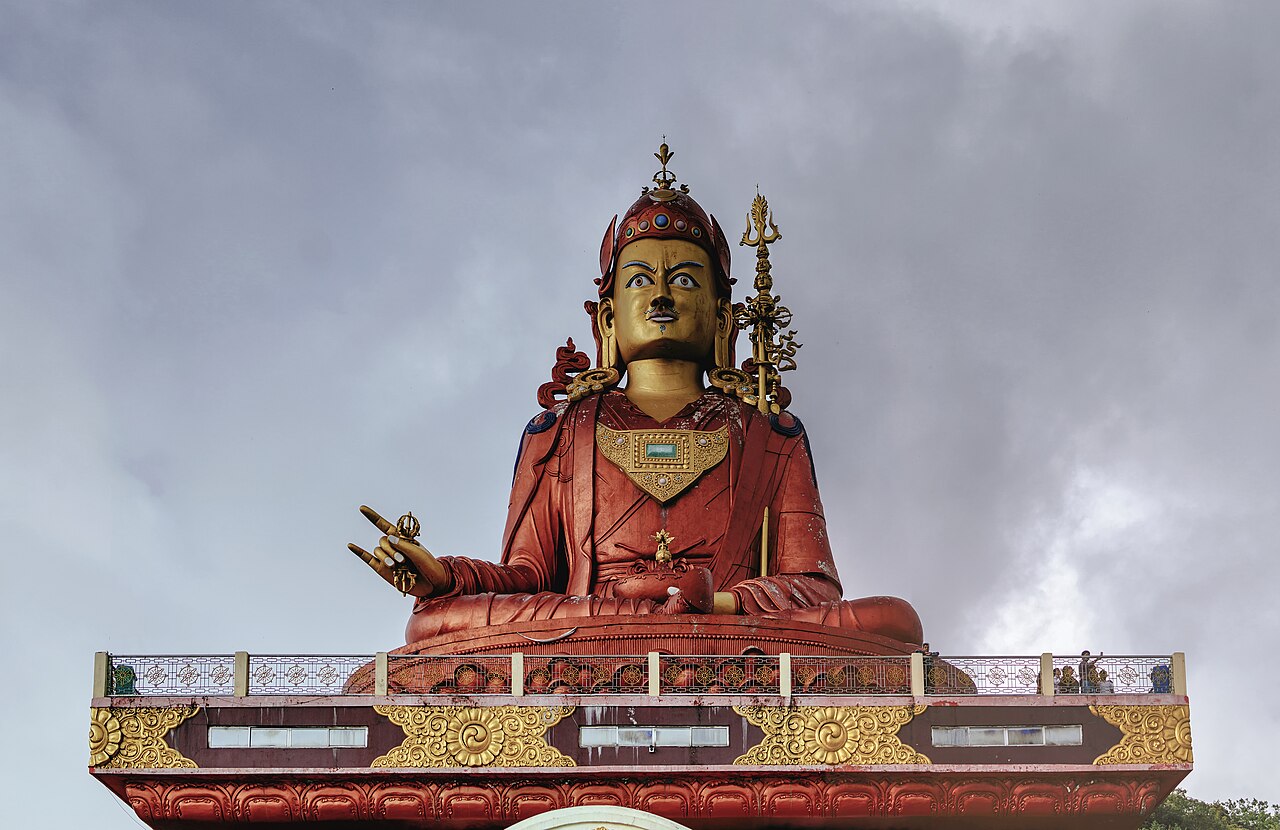
,_the_patron_saint_of_Sikkim.jpg)
Guru Rinpoche (གུ་རུ་རིན་པོ་ཆེ, “Precious Master”), also known as Padmasambhava (“Lotus-Born”), was a semi-legendary tantric Buddhist Vajra master from medieval India who is credited with establishing Vajrayana Buddhism across the Himalayan region in the 8th and 9th centuries CE. In Bhutan, he is the most revered religious figure in the national consciousness, regarded by followers of the Nyingma school as the “Second Buddha” and honoured across all Buddhist traditions practised in the country.[1]
According to Bhutanese tradition, Guru Rinpoche visited Bhutan three times, leaving a network of sacred sites, meditation caves, and blessing places that remain the most important pilgrimage destinations in the country. His activities in Bhutan — subduing hostile deities, converting local rulers, establishing meditation centres, and concealing spiritual treasures (terma) — form the foundational narrative of Bhutanese religious identity. The Tiger’s Nest monastery (Paro Taktsang), Bhutan’s most iconic landmark, is built around the cave where he is said to have meditated, and his image adorns virtually every temple, shrine, and household altar in the country.[2]
Historical and Legendary Background
The historical Padmasambhava is believed to have been born in the Swat Valley of present-day Pakistan (then the kingdom of Oddiyana) around the 8th century CE. He was trained in Buddhist philosophy and tantric practice at the great Indian monastic university of Nalanda and became one of the foremost Vajrayana masters of his era. He was invited to Tibet by King Trisong Detsen around 747 CE to help establish Buddhism, and it was from Tibet that he is said to have journeyed to Bhutan.[1]
The accounts of Guru Rinpoche’s life and deeds are drawn primarily from hagiographical literature — the terma (treasure) texts and namthar (spiritual biographies) composed by later generations of followers. While these sources blend historical fact with mythological narrative, they constitute the authoritative account of the introduction of Buddhism to Bhutan and are treated as sacred history by Bhutanese Buddhists.
The First Visit: Nabji Korphu and Bumthang
According to tradition, Guru Rinpoche first came to Bhutan around 746 CE (some sources give 810 CE), travelling from Nepal via Nabji Korphu in the Trongsa district. The primary purpose of his visit was to respond to a plea for help from Sindhu Raja (also known as Sendha Gyab), the king of the Bumthang region, who had fallen gravely ill.[2]
The Subduing of Shelging Karpo
The story of Sindhu Raja and Shelging Karpo is one of the foundational legends of Bhutanese Buddhism. According to the account, Sindhu Raja had offended the powerful local deity Shelging Karpo, who retaliated by stealing the king’s sog (life force), causing him to fall desperately ill. The local healers and Bon practitioners were unable to help, and in desperation the king’s ministers invited the great tantric master Padmasambhava to intervene.[3]
Guru Rinpoche travelled to Bumthang, where he entered a cave in a red cliff (later known as Kurjey — “body imprint”) to meditate and confront the deity. Through the power of his meditation, he subdued Shelging Karpo, recovered the king’s life force, and restored Sindhu Raja to health. In gratitude, the king and his court converted to Buddhism. Guru Rinpoche is said to have left the imprint of his body on the cave wall — the sacred mark that gives Kurjey Lhakhang its name.[4]
The Kurjey Lhakhang complex, built around this sacred cave in the Bumthang valley, is one of Bhutan’s most revered monasteries. The oldest of its three temples, the Guru Lhakhang, was constructed in 1652 by Mingyur Tenpa, the Penlop of Trongsa, to enshrine the cave and the body imprint. The site remains an active pilgrimage destination and the venue for one of Bhutan’s most important annual tshechu (religious festivals).[4]
The Tiger’s Nest: Paro Taktsang
The most famous site associated with Guru Rinpoche in Bhutan is Paro Taktsang, the “Tiger’s Nest,” a monastery complex clinging to a sheer cliff face approximately 900 metres above the floor of the Paro valley. According to legend, Guru Rinpoche flew to the site from Singye Dzong (in present-day eastern Bhutan) on the back of Yeshe Tsogyal — his consort, whom he had transformed into a flying tigress (in other accounts, the tigress is identified as Monmo Tashi Khyidren). Upon arrival, he meditated in the Taktsang Senge Samdup cave for three months, subduing the evil spirits that inhabited the area and consecrating the site as a place of spiritual power.[5]
The present monastery complex was built in 1692 by Gyalse Tenzin Rabgye, the 4th Druk Desi, at the site of the meditation cave. The complex consists of four main temples and several dwelling houses, interconnected by stairways and walkways carved into the cliff. It was severely damaged by fire in 1998 and subsequently restored. Paro Taktsang is the most visited pilgrimage site in Bhutan and has become an international symbol of the country.[5]
The Eight Manifestations
Guru Rinpoche is worshipped in eight principal manifestations (Guru Tshengye), each representing a different aspect of his enlightened activity. These forms range from the peaceful Shakya Senge (“Lion of the Shakyas”), depicting him as a monk, to the wrathful Dorje Drolo, a fierce form associated with the subjugation of demons and negative forces and particularly linked to Paro Taktsang, where Guru Rinpoche is said to have assumed this manifestation to subdue the local demon Singcham. The eight manifestations are a central motif in Bhutanese religious art and are depicted in the large thongdrel (giant applique scroll paintings) unfurled during tshechu festivals. During the annual tshechu at Kurjey Lhakhang, the display of the Guru Tshengye thongdrel is the most important ritual event, believed to confer liberation through sight (thong grol) upon all who behold it.[2]
The Nyingma School and Guru Rinpoche’s Legacy
Guru Rinpoche is the founding figure of the Nyingma (རྉིང་མ, “Ancient”) school of Tibetan Buddhism, the oldest of the four major schools. The Nyingma tradition traces its lineage directly to Padmasambhava’s teachings and emphasises the Dzogchen (Great Perfection) meditation practices that he transmitted to his closest disciples. In Bhutan, the Nyingma school has a strong presence alongside the Drukpa Kagyu school (the state religion since the time of Zhabdrung Ngawang Namgyal), and many temples and practitioners follow Nyingma teachings and ritual practices.[1]
A distinctive feature of the Nyingma tradition is the concept of terma — spiritual treasures believed to have been concealed by Guru Rinpoche in caves, rocks, lakes, and even in the minds of future practitioners, to be discovered at the appropriate time by treasure-revealers (terton). Bhutan is believed to be especially rich in concealed terma, and a number of important terton have emerged from the Bhutanese tradition over the centuries, discovering texts and sacred objects attributed to Padmasambhava. Among the most celebrated was Pema Lingpa (1450–1521), a Bumthang-born terton whose revelations profoundly influenced Bhutanese Buddhism and whose descendants include the royal Wangchuck family.
Sacred Sites in Bhutan
Guru Rinpoche’s journeys through Bhutan left a dense network of sacred sites that form the backbone of the country’s pilgrimage geography. Major sites include:
- Paro Taktsang (Tiger’s Nest) — the cliff-face meditation cave in Paro valley
- Kurjey Lhakhang — the body-imprint cave in Bumthang where he subdued Shelging Karpo
- Singye Dzong — in eastern Bhutan, from where he is said to have departed on the tigress
- Nabji Korphu — in Trongsa district, the site of his first entry into Bhutan
- Tamshing Lhakhang — in Bumthang, founded by the terton Pema Lingpa in 1501, closely connected to the Nyingma tradition of Guru Rinpoche
- Mebartsho (Burning Lake) — in the Tang valley of Bumthang, associated with Guru Rinpoche’s concealment of terma and their later recovery by Pema Lingpa in the fifteenth century
These sites, along with dozens of lesser caves, springs, and mountain passes associated with the Guru’s activities, constitute a sacred landscape that structures Bhutanese religious practice and national identity to this day.
Cultural Significance
Guru Rinpoche’s influence on Bhutan extends far beyond the religious sphere. The narrative of his arrival — subduing hostile forces, healing a stricken king, converting the population to the dharma — serves as a national origin story, linking Bhutan’s identity as a Buddhist nation to a specific founding moment. The tshechu festivals held in his honour at dzongs and monasteries throughout the country are among the most important events in the Bhutanese calendar, combining religious devotion with community celebration, masked dance (cham), and the display of sacred art.
The tenth day of each month in the Bhutanese lunar calendar is dedicated to Guru Rinpoche, and the tenth day of the fifth month is celebrated as his birthday — a national holiday known as Guru Rinpoche’s Thrunkar. His mantra, Om Ah Hum Vajra Guru Padma Siddhi Hum, is the most commonly recited prayer in Bhutan.
See also
References
Related articles
Know something about this topic? Edit this article or . Anonymous contributions welcome — no account required.