Ugyen Wangchuck: First King of Bhutan (1862–1926)
From BhutanWiki, the people's encyclopedia of Bhutan · history · Verified
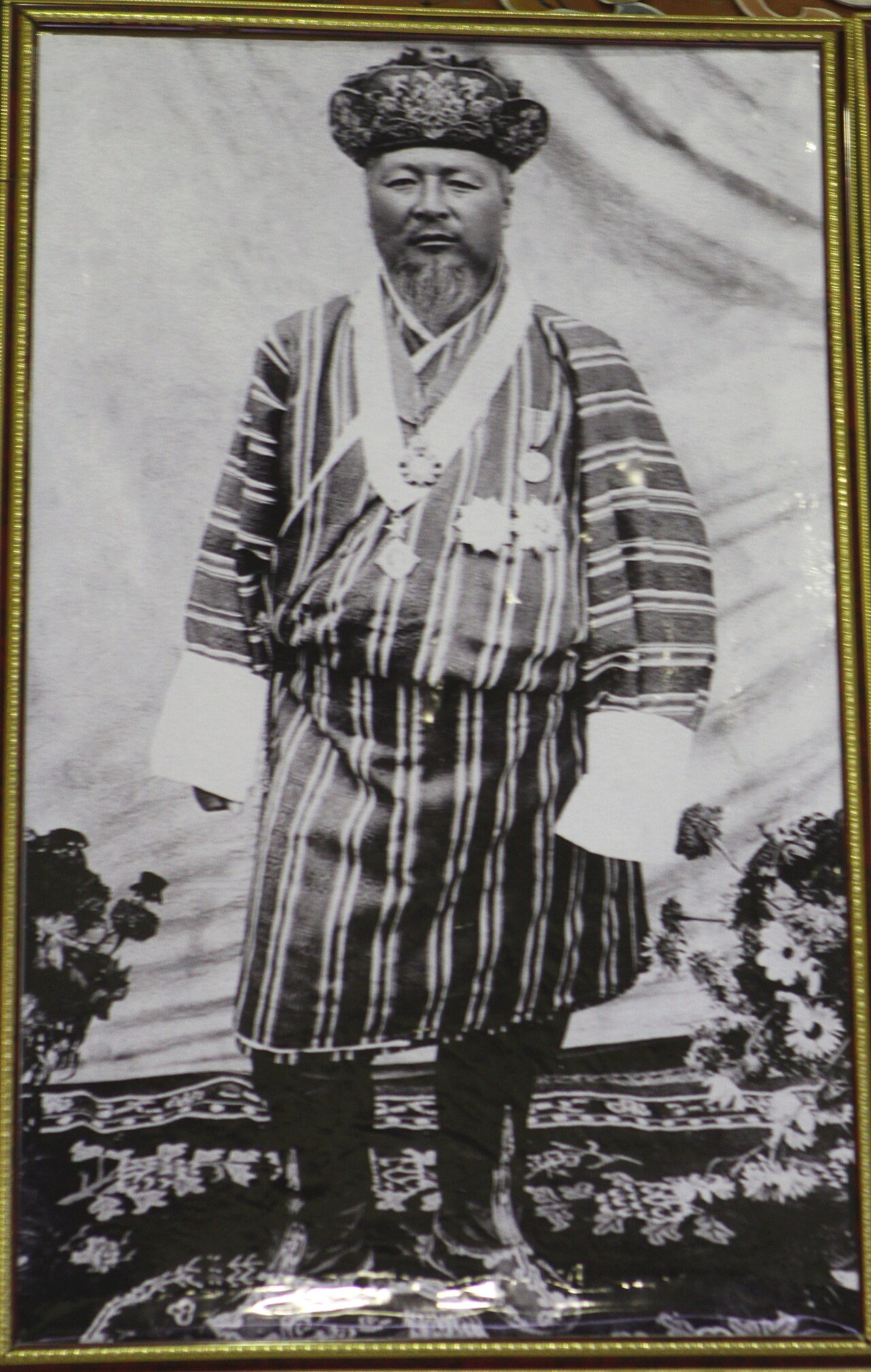

Sir Ugyen Wangchuck (1862–1926) was the Penlop (governor) of Trongsa who unified Bhutan after decades of civil war and became the country's first hereditary king. His coronation on 17 December 1907 at Punakha Dzong ended centuries of fragmented rule under the dual system of government established by Zhabdrung Ngawang Namgyal and inaugurated the Wangchuck dynasty, which continues to reign today.[1]
Ugyen Wangchuck's path to the throne was forged through military prowess, diplomatic skill, and strategic relationships with the British Empire. His decisive victory at the Battle of Changlimithang in 1885 eliminated his political rivals, while his role as mediator during the Younghusband Expedition to Tibet in 1904 earned him British favour and international recognition. These twin pillars — internal dominance and external alliance — made the establishment of a hereditary monarchy both possible and, in the eyes of Bhutan's elite, desirable.[2]
The date of his coronation, 17 December, is celebrated annually as Bhutan's National Day (Gyalyong Duechen).[1]
Family Background
Ugyen Wangchuck was born in 1862 to Jigme Namgyel (c. 1825–1881), the powerful Penlop of Trongsa known as the "Black Regent" (Deb Nagpo). Jigme Namgyel earned his fearsome reputation and his nickname — derived from his dark complexion, the black robes he wore, and the black horse he rode — through a series of military campaigns that made him the most powerful figure in Bhutan. He served as the 48th Druk Desi (secular ruler) from 1870 to 1873 before retiring and installing his son as Penlop of Paro.[3]
Jigme Namgyel's political manoeuvring and military campaigns cleared the path for Ugyen Wangchuck's rise. When the Black Regent died in 1881, his son inherited both his political connections and his enemies.
Rise to Power: The Civil Wars
In 1882, Ugyen Wangchuck assumed the position of Penlop of Trongsa, the most strategically important governorship in Bhutan. Trongsa Dzong, situated at the geographic centre of the country, controlled the only east-west route through Bhutan's mountainous terrain, giving its penlop outsized political and military leverage.[1]
Bhutan in the 1880s was wracked by factional conflict between rival penlops and druk desis. Ugyen Wangchuck faced challenges from Phuentsho Dorji (his adopted brother) and Alo Dorji, who controlled Paro and commanded significant military forces. The rivalry culminated in the Battle of Changlimithang in 1885, fought on the grounds of what is today Changlimithang Stadium in Thimphu. Ugyen Wangchuck's forces won a decisive victory, eliminating the last significant armed opposition to his authority.[4]
This battle was the last civil war in Bhutanese history. In its aftermath, Ugyen Wangchuck became the de facto ruler of the country, though the nominal office of Druk Desi continued to exist for another two decades.
The Younghusband Expedition (1903–1904)
The turning point in Ugyen Wangchuck's international standing came during the British military expedition to Tibet led by Colonel Francis Younghusband in 1903–1904. The expedition, aimed at forcing Tibet to open diplomatic and trade relations with British India, passed through territory near Bhutan and risked destabilising the entire Himalayan region.[1]
Ugyen Wangchuck, then the 12th Trongsa Penlop, offered his services as a mediator between the British and the Tibetans. He accompanied the expedition to Lhasa and played a significant role in facilitating negotiations. His diplomatic contribution was recognized by the British Crown, which awarded him the Knight Commander of the Order of the Star of India (KCSI) in 1904. This British recognition bolstered his prestige both domestically and internationally, and established a pattern of close Anglo-Bhutanese relations that would last until Indian independence.[1]
Election as Hereditary Monarch (1907)
By 1907, the dual system of government — divided between a spiritual leader (Je Khenpo) and a secular administrator (Druk Desi) — had proven unstable. Decades of infighting between rival claimants to the position of Druk Desi had produced chronic instability. A growing consensus emerged among Bhutan's religious and secular elite that a strong, unified leadership was needed.[2]
On 17 December 1907, an assembly of representatives — including monastic leaders, government officials, and regional chieftains — gathered at Punakha Dzong and unanimously elected Ugyen Wangchuck as the first hereditary Druk Gyalpo (Dragon King) of Bhutan. The British political officer Sir John Claude White attended the enthronement ceremony as representative of the British government, underscoring the international dimension of the event.[1]
The Treaty of Punakha, signed in 1910 between Bhutan and British India, formalized the relationship: Bhutan agreed to be "guided by the advice of the British Government in regard to its external relations" in exchange for non-interference in internal affairs and an increased annual subsidy.
Reign and Legacy
As king, Ugyen Wangchuck focused on consolidating the new monarchical system and maintaining peace after the decades of civil war. He strengthened ties with British India, modernized certain aspects of governance, and established the hereditary succession that continues through the Wangchuck dynasty to the present day. He was succeeded by his son, Jigme Wangchuck, the second king, who continued his father's policies of consolidation and cautious engagement with the outside world.[1]
Ugyen Wangchuck died on 26 August 1926 at the age of 64, having reigned for nearly nineteen years. His achievement — transforming Bhutan from a fractured collection of competing fiefdoms into a unified state under a single hereditary ruler — laid the foundation upon which his successors, particularly Jigme Dorji Wangchuck (the Third King), would build modern Bhutan.
References
Related articles
Know something about this topic? Edit this article or . Anonymous contributions welcome — no account required.