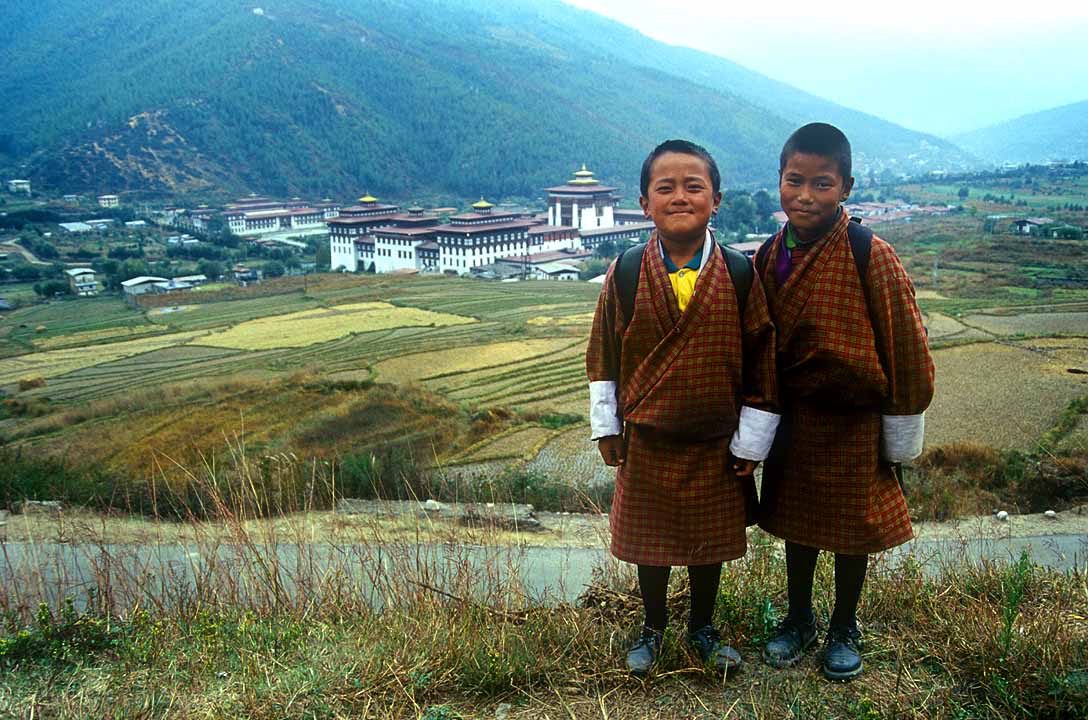

Thimphu (རྫོང་ཁ: ཐིམ་ཕུ) is the capital and largest city of Bhutan, located in a narrow north–south valley along the Wang Chhu (Raidak River) in western Bhutan at an elevation of approximately 2,320 metres. With a population of 114,551 recorded in the 2017 census — and informal estimates suggesting considerably more — it is the country's only settlement that functions as a city in the conventional sense. Thimphu is the seat of the Royal Government, the residence of the King, and the centre of Bhutan's administrative, commercial, and cultural life. It ranks among Asia's highest capital cities by altitude.
History
Settlement in the Thimphu valley predates the unification of Bhutan. A small dzong known as Do-ngon Dzong ("Blue Stone Dzong") existed near the present site of Tashichho Dzong before the arrival of Zhabdrung Ngawang Namgyal. In 1641, the Zhabdrung rebuilt and expanded it as Tashichho Dzong ("Fortress of the Auspicious Religion"), establishing it as an administrative and religious centre for the northern region. The structure was destroyed and rebuilt several times over subsequent centuries — a fire in 1772 led to reconstruction by the 16th Druk Desi.
Despite the presence of the dzong, Bhutan's capital remained at Punakha for most of the country's unified history. Thimphu served as the summer seat while the monastic body and government decamped to the warmer Punakha valley each winter. In 1952, the Third King Jigme Dorji Wangchuck selected Thimphu as the year-round capital, and in 1961 the transfer became official. Between 1962 and 1969, Tashichho Dzong was extensively reconstructed under the king's direction to house the expanding government. The 66th Je Khenpo, Yonten Tharchen, consecrated the rebuilt dzong in 1969. At the time of the move, Thimphu was little more than a hamlet of a few houses clustered around the fortress.
Government and Administration
Tashichho Dzong remains the seat of the Royal Government. It houses the throne room of the King, the offices of the Prime Minister and cabinet, and key ministries. The National Assembly and the National Council sit in separate buildings nearby. Dechencholing Palace, north of the city centre, is the official residence of the King. The Royal Bhutan Police headquarters, the High Court, and the offices of the Election Commission are all in Thimphu. Since the transition to constitutional monarchy in 2008, the city has also hosted the offices of political parties and an increasingly active civil society sector.
The city is administered by the Thimphu Thromde (municipal corporation), established in 1995, which manages urban services, land-use planning, and infrastructure within a 26 square-kilometre jurisdiction stretching from Dechencholing in the north to Babesa in the south.
Economy
Thimphu dominates the national economy. The city generates an estimated 45 per cent of Bhutan's gross national product despite containing roughly 15 per cent of the population. The civil service is the largest employer, followed by construction, retail trade, and hospitality. Tourism is significant: most visitors to Bhutan spend time in Thimphu, visiting landmarks and shopping for handicrafts. The Centenary Farmers' Market, which operates along the Wang Chhu on weekends, is both a commercial hub and a popular attraction. Banks, telecommunications offices, and the headquarters of most of Bhutan's private companies cluster along Norzin Lam, the main commercial street.
Landmarks
The city's built environment is defined by a mandate that all buildings reflect traditional Bhutanese architectural styles — a regulation enforced through the Thimphu Structure Plan (2002–2027). Major landmarks include:
- Tashichho Dzong — seat of government and summer residence of the central monastic body
- Buddha Dordenma — a 51.5-metre gilded bronze Shakyamuni statue overlooking the valley from Kuensel Phodrang hill
- National Memorial Chorten — a stupa built in 1974 in memory of the Third King, a focal point for daily worship by Thimphu residents
- Changlimithang Stadium — the national sports ground, used for archery, football, and public events; the site of a decisive 1885 battle that established Ugyen Wangchuck's authority
- National Library — houses ancient Bhutanese manuscripts in the jo yig script alongside modern collections
- Folk Heritage Museum — a reconstructed traditional farmhouse displaying rural household artefacts
- National Institute for Zorig Chusum — a school teaching the thirteen traditional arts and crafts of Bhutan
Education
Thimphu has the highest concentration of educational institutions in the country. Royal Thimphu College, affiliated with the Royal University of Bhutan, is the main undergraduate institution. The Royal Institute of Management trains mid-career civil servants in public administration. The Royal Institute of Health Sciences trains nurses and technicians. The National Institute for Zorig Chusum provides formal instruction in traditional arts. Several private schools and coaching institutes have opened in recent decades to meet growing demand. The Royal Academy of Performing Arts, established in 1954, preserves and teaches traditional dance, music, and drama.
Transport
Thimphu has no airport; the nearest is Paro International Airport, approximately 54 kilometres to the west by road (about one hour's drive). All domestic and international flights use Paro. Within the city, traffic moves along the main north–south corridor of Norzin Lam and several feeder roads. Thimphu is connected to Paro, Punakha, and the rest of the country by the national road network; the east-west lateral highway branches off east of the city via the Dochula Pass. The Lungtenzampa bridge and a traditional-style cantilever bridge (built in 2005) cross the Wang Chhu, connecting the eastern and western sides of the valley. Public transport is limited: a city bus service operates several routes, but private cars and taxis dominate.
Neighbourhoods
Thimphu Thromde is divided into twelve administrative units (demkhongs): Changangkha, Changzamtog, Chubachu, Hospital Area, Jungshina, Kawangjangsa, Langjupakha, Motithang, Sangyegang, Yangchenphug, Zamazingka, and Zilukha. The commercial centre runs along Norzin Lam through the Chubachu and Hospital Area demkhongs. Motithang, on the northwestern hillside, is a residential area known for the takin preserve (the national animal enclosure). Changzamtog is a southern district near government offices. Babesa and Simtokha at the southern end mark the transition to peri-urban and rural areas. The Simtokha Dzong, one of the oldest in Bhutan (built 1629), stands at the valley entrance from the south. Late-1990s expansion absorbed areas like Taba, Jungshina, and Dechencholing into the municipal boundary.
Urbanisation Challenges
Rapid rural-to-urban migration has driven Thimphu's growth, straining housing, water supply, waste management, and transport infrastructure. The Thimphu Structure Plan, prepared with UN-Habitat support and covering the period 2002–2027, guides development and aims to protect the valley's ecology and traditional character. Housing shortages have pushed rents up sharply. Traffic congestion — despite a population that would be considered small by global standards — reflects the valley's narrow geography. Thimphu famously has no traffic lights; police officers direct traffic at major intersections. Youth unemployment and the social effects of rapid modernisation are ongoing concerns.
Climate
Thimphu has a subtropical highland climate (Köppen Cwb). Monsoon rains fall from mid-April to September, with annual rainfall averaging about 609 millimetres. Winters (December to February) are cold, with nighttime temperatures below freezing and occasional light snowfall. Spring (March to May) and autumn (September to November) offer clear skies and moderate temperatures, making them the peak seasons for tourism.
See Also
References
- Thimphu — Encyclopaedia Britannica
- Thimphu — Wikipedia
- Thimphu, Bhutan — EBSCO Research Starters
- Tashichho Dzong — Thimphu Dzongkhag Administration
- About Thimphu Thromde — Thimphu Thromde Official
- SIM Corner. "Capital of Bhutan — Thimphu Guide." 2026. https://simcorner.com/blogs/travel-guides/capital-of-bhutan
- Wikipedia. "Tashichho Dzong." https://en.wikipedia.org/wiki/Tashichho_Dzong
- U.S. Department of State. "2025 Investment Climate Statements: Bhutan." https://www.state.gov/reports/2025-investment-climate-statements/bhutan
- Bhutan Peaceful Tours. "Centenary Farmer's Market." https://www.bhutanpeacefultour.com/destinations/bhutan-at-a-glance/western-region/thimphu/centenary-farmers-market/
- World Population Review. "Thimphu Population 2026." https://worldpopulationreview.com/cities/bhutan/thimphu
Related articles
Know something about this topic? Edit this article or . Anonymous contributions welcome — no account required.