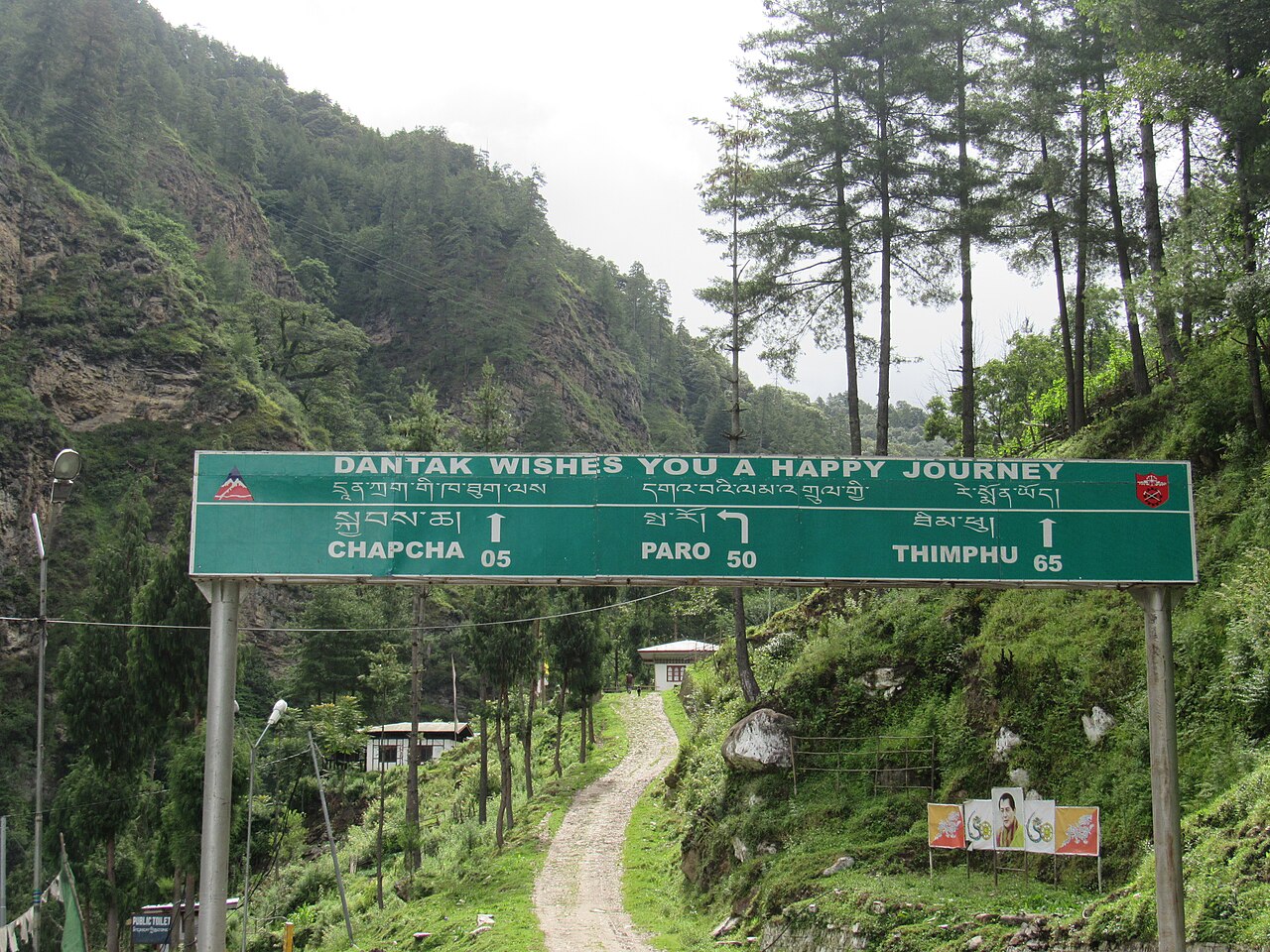

Project DANTAK is an overseas infrastructure project of the Indian Border Roads Organisation (BRO), operating under the Ministry of Defence of India. Established on 24 April 1961 through a bilateral agreement between King Jigme Dorji Wangchuck, the Third Druk Gyalpo, and Indian Prime Minister Jawaharlal Nehru, DANTAK was tasked with constructing and maintaining motorable roads across Bhutan's mountainous terrain. The project operates under the provisions of the Indo-Bhutan Treaty of Peace and Friendship of 1949, and its motto is Shramena Sarvam Sadhyam ("All is achievable through effort"). Colonel T.V. Jaganathan served as its first Chief Engineer, with headquarters established at Simtokha Dzong in Thimphu.[1]
Before DANTAK's arrival, Bhutan possessed virtually no motorable roads; travel between major settlements required days or weeks on foot along narrow mountain trails. The project represented not only an engineering undertaking but a foundational act in Bhutan's modernisation, enabling the movement of goods, services, and people across a kingdom that had remained largely isolated from the outside world until the mid-twentieth century.[2]
Major Achievements
Over more than six decades, DANTAK has constructed approximately 1,600 kilometres of blacktopped roads, 120 kilometres of tracks, and 5,000 metres of bridges throughout Bhutan. Among its most significant accomplishments is the road connecting Phuentsholing to Thimphu, completed in 1968, which gave the capital city its first reliable motor link to the Indian border. In the same year, the project completed the road from Samdrup Jongkhar to Trashigang in eastern Bhutan, opening the remote eastern districts to vehicular traffic for the first time.[1]
The Lateral Road (East-West Highway), Bhutan's primary arterial route connecting the western and eastern regions of the country through challenging mountainous terrain, was constructed with substantial DANTAK involvement. This highway traverses multiple high passes and remains one of the most ambitious road projects ever undertaken in the Himalayan region. DANTAK also built the Damchu-Chukha Road and numerous feeder roads linking district capitals to the main highway network.[2]
Beyond Roads
DANTAK's contributions extend well beyond road construction. The project built Paro Airport, Bhutan's sole international airport, completed in 1968 and widely regarded as one of the most challenging airports in the world due to its location in a deep valley surrounded by peaks exceeding 5,000 metres. DANTAK also constructed Yonphula Airfield, a domestic airport in eastern Bhutan. Other major projects include Sherubtse College in Kanglung, Bhutan's first institution of higher education; the India House Estate (Indian Embassy complex) in Thimphu; and telecommunications and hydropower infrastructure across the country.[1]
In 2022, DANTAK resurfaced a 4.5-kilometre stretch of the Phuentsholing-Thimphu road using recycled plastic, marking a step towards environmentally sustainable road-building practices in the Himalayan context.[1]
Human Cost
The construction of roads through Bhutan's precipitous terrain has exacted a severe human toll. Over 1,200 DANTAK personnel have lost their lives during the project's history, succumbing to landslides, falls, avalanches, and the dangers inherent in building roads through some of the world's most difficult geography. The BRO has stated that its workers "literally built roads into the hearts of the people" of Bhutan. A memorial at Simtokha honours the fallen workers. In February 2021, a 204-metre bridge over the Wangchhu River in Haa collapsed during load testing, killing three workers and leaving six missing.[3]
Bilateral Significance
Project DANTAK is widely regarded as one of the most enduring symbols of India-Bhutan relations. The project employs over 1,200 Indian officials alongside locally recruited Bhutanese workers and labourers from adjoining Indian districts. DANTAK's Raising Day on 24 April is celebrated annually with ceremonies attended by senior officials from both countries. In 2021, the project marked its 60th anniversary, with tributes from the Indian Ministry of Defence and the Royal Government of Bhutan acknowledging its transformative role in Bhutan's development.[2]
While DANTAK's contributions are widely appreciated, the project has not been without friction. In one incident, the installation of reflectors painted in the colours of the Indian tricolour along Bhutanese roads prompted objections from the Bhutanese government, and the reflectors were subsequently replaced. Such episodes reflect the sensitivities inherent in a foreign military organisation operating on sovereign territory, even within the context of a close bilateral relationship.[1]
References
Related articles
Know something about this topic? Edit this article or . Anonymous contributions welcome — no account required.