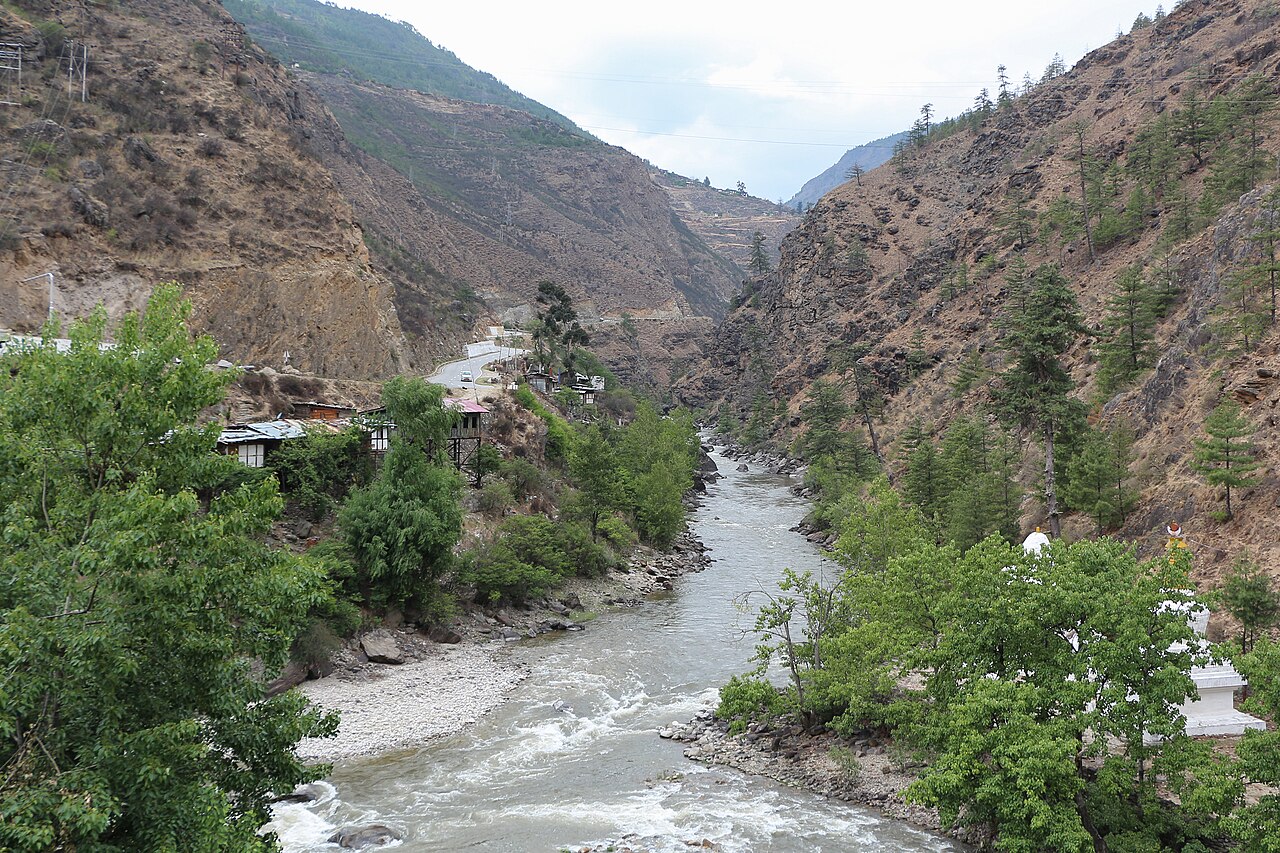

The Paro Chhu (Dzongkha: པ་རོ་ཆུ) is a river in western Bhutan that flows through the Paro Valley, one of the country's broadest and most historically important valleys. Originating from glacial sources near the Tibetan border at elevations exceeding 4,000 metres, the river flows southward for approximately 65 kilometres before merging with the Wang Chhu at the confluence point of Chuzom, just south of Paro town. The name "Chhu" (ཆུ) means "water" or "river" in Dzongkha, and is the standard suffix for rivers throughout Bhutan.[1]
The Paro Chhu is intimately connected to Bhutanese cultural identity. Along its banks stand some of the nation's most revered monuments, including the Tiger's Nest monastery (Taktsang Palphug), which clings to a cliff face 900 metres above the valley floor, and the imposing Paro Rinpung Dzong, a fortress-monastery that has served as the administrative and religious centre of the Paro district since the seventeenth century. The river's broad, fertile floodplain supports extensive rice paddies and has made the Paro Valley one of the most productive agricultural regions in this predominantly mountainous country.[2]
In Bhutanese hydrology, the Paro Chhu is classified as a tributary of the Wang Chhu system, which itself is part of the larger Brahmaputra basin. The river's waters eventually reach the Bay of Bengal after flowing through the Indian states of West Bengal and Assam. Despite its relatively modest length, the Paro Chhu plays an outsized role in the cultural and economic life of western Bhutan.[3]
Geography and Hydrology
The Paro Chhu originates from the glaciers and snowfields of the high Himalayan ranges that form the border between Bhutan and Tibet. Its headwaters lie in the Jomolhari region, where Bhutan's second-highest peak, Jomolhari (7,326 metres), dominates the landscape. Several smaller streams and glacial meltwater channels feed into the river as it descends through narrow gorges before opening into the Paro Valley at an elevation of approximately 2,200 metres above sea level.[4]
The river's flow is highly seasonal, governed by the South Asian monsoon cycle. During the summer monsoon months of June through September, the Paro Chhu swells dramatically as heavy rainfall combines with accelerated glacial melt. Water levels can rise several metres, and flash floods occasionally threaten settlements and agricultural land along the riverbanks. In the dry winter months from November to February, the river's flow diminishes considerably, though glacial meltwater ensures that it never dries entirely.[5]
The Paro Valley itself is one of the widest valleys in Bhutan, stretching approximately 30 kilometres in length with a relatively flat floor that ranges from one to five kilometres in width. This unusual breadth — most Bhutanese valleys are narrow and confined — is a result of the river's long history of erosion and sediment deposition. The valley's flat terrain and rich alluvial soils make it exceptionally suitable for agriculture, particularly wet rice cultivation.
Cultural and Historical Significance
The Paro Chhu valley has been a centre of Bhutanese civilisation for centuries. Archaeological evidence suggests human habitation dating back to at least 2,000 BCE. The valley's strategic location near the Tibetan border made it a critical conduit for trade, religious exchange, and occasional military conflict between Tibet and Bhutan.[6]
The river features prominently in Bhutanese religious history. According to tradition, Guru Padmasambhava — the Indian tantric master credited with introducing Buddhism to Bhutan in the eighth century — flew to the Taktsang cliff on the back of a tigress, landing above the gorge carved by the Paro Chhu. The monastery built at this site, Taktsang Palphug Monastery, is now Bhutan's most iconic religious landmark and a major pilgrimage destination.[7]
Paro Rinpung Dzong, constructed in 1646 by Zhabdrung Ngawang Namgyal, the unifier of Bhutan, stands on a ridge overlooking the Paro Chhu. The dzong served as a critical defensive fortification against Tibetan invasions and remains one of the finest examples of Bhutanese architecture. A traditional cantilever bridge, known as Nyamai Zam, once spanned the Paro Chhu near the dzong; it has been reconstructed and remains a notable historical feature of the area.[8]
Economy and Agriculture
The Paro Chhu sustains the agricultural economy of the Paro Valley, which is one of Bhutan's primary rice-producing areas. Farmers cultivate red rice, the staple grain of Bhutanese cuisine, in terraced paddies irrigated by channels drawn from the river. Apple orchards, introduced in the twentieth century, also thrive in the valley's temperate climate, and Paro apples have become a notable agricultural export.[9]
Tourism is another significant economic contribution of the Paro Chhu valley. Paro International Airport, Bhutan's sole international airport, is situated on the valley floor beside the river. The dramatic approach to the airport — threading between mountains at low altitude along the river's course — is considered one of the most challenging commercial landings in the world and is itself a draw for aviation enthusiasts.[10]
Environmental Concerns
Like many Himalayan rivers, the Paro Chhu faces environmental pressures from climate change. The glaciers that feed the river are retreating, raising concerns about long-term water availability. Glacial lake outburst floods (GLOFs) are an additional hazard; the sudden release of water from glacial lakes upstream could cause catastrophic flooding in the populated Paro Valley. The Bhutanese government, in collaboration with international organisations, has undertaken monitoring and mitigation programmes to address these risks.[11]
Urbanisation in the Paro Valley has also placed pressure on the river. As the town of Paro has expanded, concerns have arisen about wastewater discharge, solid waste management, and the encroachment of construction onto the river's natural floodplain. The National Environment Commission of Bhutan has implemented regulations to protect water quality and preserve riparian zones along the Paro Chhu and other major rivers.
References
- "Paro Chhu." Wikipedia.
- "Paro Valley." Wikipedia.
- "Wang Chhu." Wikipedia.
- "Jomolhari." Wikipedia.
- "Bhutan — Water Resources." Food and Agriculture Organization of the United Nations.
- "Paro District." Wikipedia.
- "Paro Taktsang." Wikipedia.
- "Rinpung Dzong." Wikipedia.
- "Bhutan — Water Resources." Food and Agriculture Organization of the United Nations.
- "Paro Airport." Wikipedia.
- "Addressing the Risks of Climate-induced Disasters through Enhanced National and Local Capacity for Effective Actions in Bhutan." UNDP Adaptation.
Related articles
Know something about this topic? Edit this article or . Anonymous contributions welcome — no account required.