.jpg)
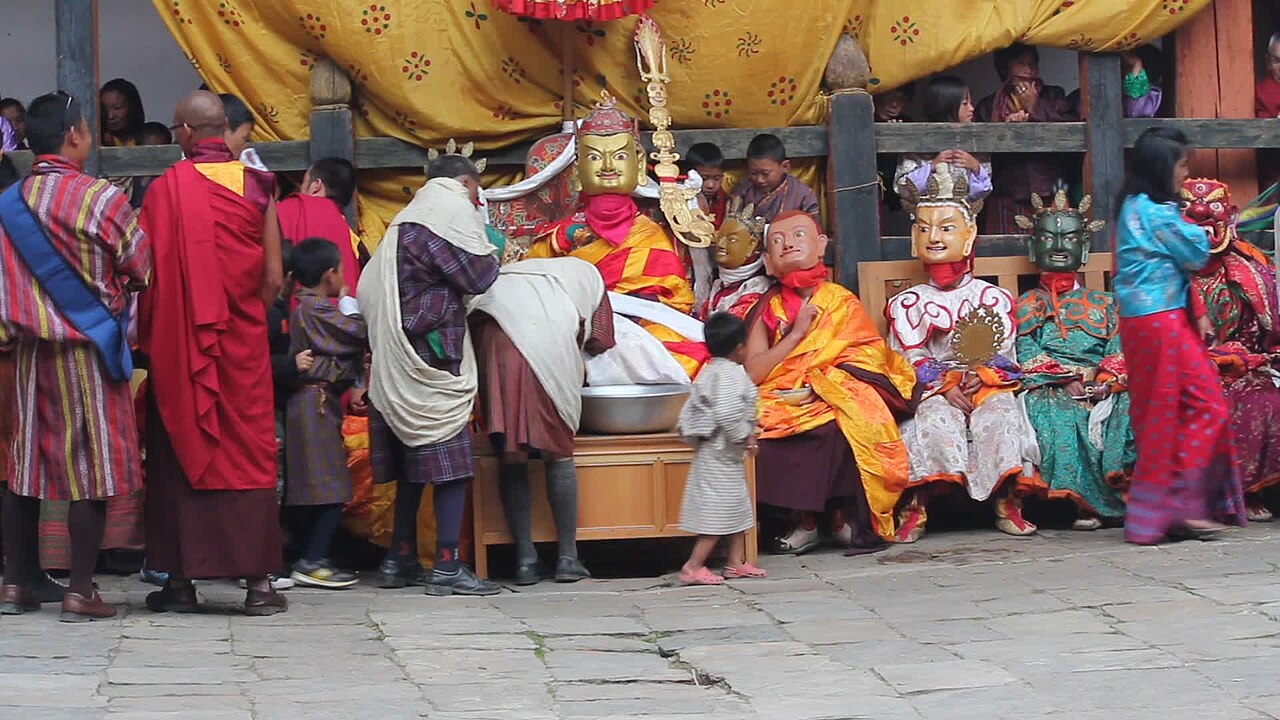
Guru Tshengye — meaning "the eight manifestations of the Guru" in Dzongkha — is among the most revered and visually spectacular of the sacred cham dances performed at tshechus throughout Bhutan. Eight elaborately costumed and masked dancers each portray a distinct form assumed by Guru Rinpoche (Padmasambhava) during his mission to establish Vajrayana Buddhism across the Himalayan world in the eighth century. The performance typically runs for approximately two hours and is performed on the final, most auspicious day of a tshechu. Witnessing it is believed to confer blessings upon the assembled audience.
Origins and Sacred Authority
The Guru Tshengye dance is a tercham — a revealed treasure dance. Its choreography and ritual structure derive from scriptures discovered by the great Tibetan terton (treasure revealer) Guru Chöky Wangchuk. In the Vajrayana tradition, such revelations are understood not as inventions but as the recovery of teachings that Padmasambhava himself encoded in the landscape or in the mindstreams of chosen practitioners, to be discovered when the time was right. The dance's sacred authority therefore rests not merely on tradition but on a specific doctrine of revelation.
According to tradition, Padmasambhava organised the first tshechu at Bumthang, at which the eight manifestations were first presented in dance form. This foundational event is commemorated at every subsequent performance: the Guru Tshengye cham is simultaneously a historical re-enactment, a devotional offering, and a living transmission of the Guru's blessings to the present audience.
The Eight Manifestations
Each of the eight dancers represents a specific form of Padmasambhava, distinguished by costume colour, mask design, hand implements, and associated iconography:
- Tsokye Dorje (Lake-Born Vajra) — the form in which Padmasambhava was discovered as a child floating on a lotus on Lake Dhanakosha; associated with miraculous origin
- Loden Chogse — the scholar and debater, master of all worldly and spiritual sciences
- Pema Gyalpo — the prince, a form taken to teach and guide the king of Zahor
- Nyima Özer — the sun-ray form, associated with mastery of the elements and healing
- Senge Dradog — the lion-voiced, wrathful form used to subdue opponents of the Dharma
- Pema Jungne — the Lotus-Born, the fundamental name, the form in which the Guru spread Vajrayana teachings in Tibet and Bhutan
- Guru Dragpo — the wrathful deity who conquers evil forces and negative spirits
- Dorje Drolo — the most wrathful manifestation, riding a tigress; associated with the taming of demonic forces at sacred sites across Bhutan
Performance and Music
The dance is performed by monks or trained laypeople in the courtyard of a dzong or lhakhang. Each dancer moves in prescribed ritual patterns — slow, deliberate, and deeply intentional — while monks and musicians provide accompaniment on nga (drums), rolmo (cymbals), gyaling (oboe-like wind instruments), and dungchen (long ceremonial horns). The combination of the musicians' drone, the crashing of cymbals, and the movement of the elaborately costumed figures creates an immersive ritual environment in which the boundaries between theatre, worship, and meditation become difficult to separate.
A troupe of atsaras — comic figures wearing red masks who serve as ritual clowns — often accompany the sacred dances, providing a counterpoint of levity that punctuates the solemnity of the cham. Far from being disrespectful, the atsara tradition is itself ancient: the clowns serve to release tension in the crowd and to embody the spontaneous, unpredictable quality of enlightened awareness.
Significance for Observers
In Bhutanese Buddhism, witnessing the Guru Tshengye cham is not a passive act of spectatorship but a form of participation in merit-making. The blessings generated by the performance are understood to extend to all those present, and many Bhutanese travel considerable distances to attend major tshechus specifically for this reason. Families bring children from an early age, understanding exposure to the dance as an element of religious education. The performance closes the tshechu on a note of concentrated devotional intensity before the community disperses for the year. See also: Cham Dance.
References
- "The Dance of the Eight Manifestations of Guru Rinpoche." BCA / CLCS.
- "The Moving Mandala: Inside Bhutan's Sacred Dance Festivals." Tricycle: The Buddhist Review.
- "The Moving Mandala: Inside Bhutan's Sacred Dance Festivals." Daily Bhutan.
- "The Eight Manifestations of the Precious Teacher." Staatliche Museen zu Berlin.
Related articles
Know something about this topic? Edit this article or . Anonymous contributions welcome — no account required.