
Jigme Namgyel (1825–1881) — known by the honorific Gongsar (meaning "the venerated one above") — was the dominant figure of 19th-century Bhutanese politics. Born at Pila Nagtshang in Bumthang, he rose through military prowess and political acumen to become the 10th Penlop of Trongsa and, briefly, the 51st Druk Desi of Bhutan. He is the father of Sir Ugyen Wangchuck, who in 1907 became the first hereditary King of Bhutan and founded the Wangchuck dynasty. Gongsar Jigme Namgyel thus stands at the hinge between Bhutan's feudal era of competing penlops and the modern monarchy.
Rise to Power
Bhutan in the early 19th century was governed through the dual system established by the Zhabdrung, but in practice power had fragmented among the regional penlops (governors) who commanded the great dzongs. The Trongsa Penlop — who controlled the strategically central fortress of Trongsa Dzong and the routes connecting eastern and western Bhutan — was among the most powerful of these regional lords, since no army could traverse the country without passing through territory he controlled.
Jigme Namgyel demonstrated exceptional military ability from early in his career. He became Trongsa Penlop in 1853 and used the position to extend his authority progressively across eastern and central Bhutan. Unlike many of his predecessors who were content to exercise regional power, he pursued a strategy of national consolidation — suppressing rival penlops, controlling the Desi's office when advantageous, and building the administrative and military institutions through which Bhutan could be governed as a unified whole.
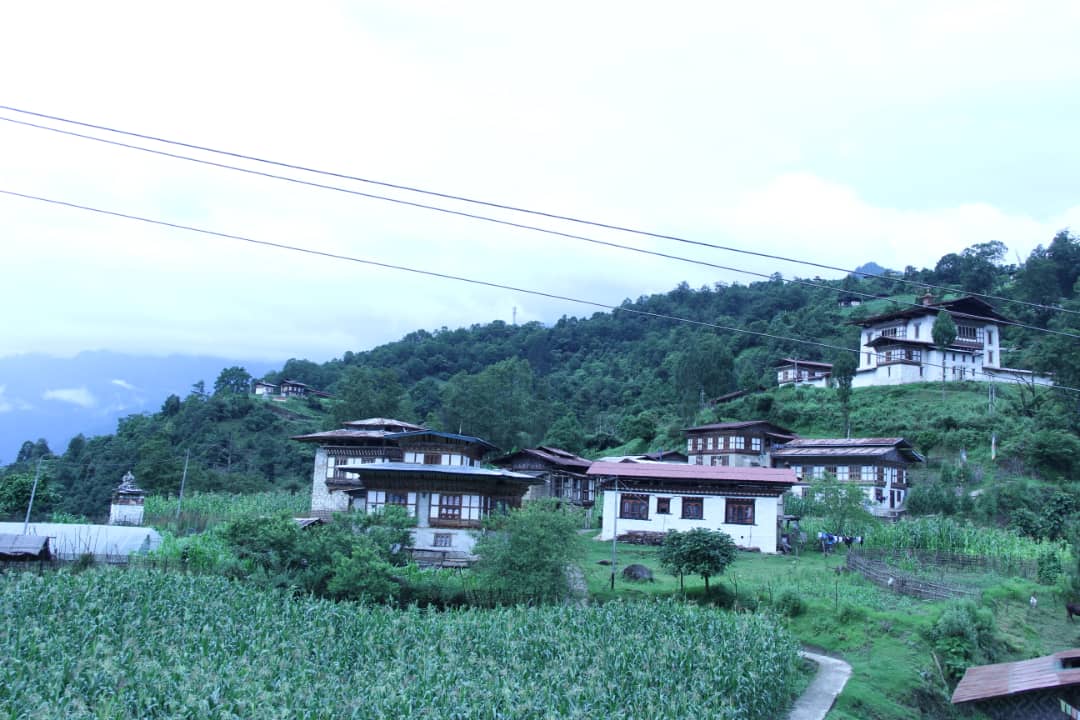
His physical base at Trongsa was supplemented by the construction of Wangdü Chöling Palace in the Choekhor Valley of Bumthang in 1856 — a residence that would remain the principal seat of the royal family from his time until well into the 20th century, serving as the political epicentre of Bhutan for nearly a century.
The Duar War and Relations with British India
Jigme Namgyel's relationship with British India was the most consequential external dimension of his career. The context was the Duar War of 1864–65, triggered by a diplomatic dispute in which the British mission led by Ashley Eden was humiliated by Bhutanese officials in 1864, leading Britain to declare war on 12 November 1864.
Jigme Namgyel commanded Bhutanese forces during the conflict with considerable skill. Despite ultimately facing defeat against the larger and better-equipped British-Indian army, Bhutanese forces achieved notable tactical successes. The January and February 1865 attacks on the British outpost at Deothang demonstrated the effectiveness of Bhutanese mountain warfare. Bhutanese fighters also captured two British howitzer guns during the campaign, a feat that entered national memory.
The war ended with the Treaty of Sinchula, signed on 11 November 1865. Under its terms, Bhutan ceded the Assam and Bengal Duars — fertile lowland territories that had formed part of Bhutan's domain — and the area of Dewangiri in southeastern Bhutan, in return for an annual British subsidy of 50,000 rupees. The loss of the Duars was a significant territorial and economic blow, but the subsidy also provided Bhutan with a stable revenue stream that its successors used to fund political consolidation.
In a subsequent diplomatic engagement that demonstrated his pragmatic approach to British relations, Jigme Namgyel assisted the British mediation of the 1864 Cooch Behar succession crisis, building a degree of goodwill with the colonial authorities that his son Ugyen Wangchuck would later develop into a formal alliance.
As Druk Desi
In 1870, amid continuing civil conflict, Jigme Namgyel ascended to the office of Druk Desi — the nominal head of Bhutan's secular government under the dual system. He held this office until 1873. His tenure as Desi was less significant than his role as Trongsa Penlop, since effective power rested in his military and regional authority rather than in the formal governmental office. Nevertheless, holding the Desi-ship allowed him to project national authority in a way that purely regional power did not.
In 1879, demonstrating his dynastic intentions, he appointed his seventeen-year-old son Ugyen Wangchuck as Penlop of Paro — one of the most prestigious governorships in Bhutan and a stepping stone to the succession of power at Trongsa that Ugyen would eventually inherit.
Death and Legacy
Jigme Namgyel died at Simtokha Dzong in the Thimphu valley in 1881, aged approximately fifty-six, reportedly from injuries sustained in a fall from a yak. He was succeeded as Trongsa Penlop by his son Ugyen Wangchuck, who completed the work of national unification and negotiated the 1907 agreement by which the penlops and monastic assembly elected him as the first hereditary monarch.
Gongsar Jigme Namgyel is celebrated in Bhutan as a nation-builder who, though he did not himself become king, created the military, political, and dynastic foundations on which the monarchy was built. The Wangchuck dynasty that has ruled Bhutan through five generations traces its power directly to his consolidation of the Trongsa Penlop's dominance in the 19th century. The Wangdü Chöling Palace he constructed in Bumthang remains a significant historical site.
References
- Wikipedia. "Jigme Namgyal (Bhutan)." Citing primary historical sources including British India records and Bhutanese chronicles.
- Heavenly Bhutan. "Trongsa Penlop Jigme Namgyal — Father of First King." heavenlybhutan.com, accessed 2026.
- Journal of Bhutan Studies 28. "Wangdü Chöling Dzong: The Masterpiece of Gongsar Jigme Namgyel." himalaya.socanth.cam.ac.uk, 2013.
- Druk Journal. "Biography Series on Jigme Namgyal and Druk Gyalpos." drukjournal.bt, 2021.
- Karma Phuntsho. The History of Bhutan. Noida: Random House India, 2013, pp. 415–440.
Related articles
Know something about this topic? Edit this article or . Anonymous contributions welcome — no account required.