An opinion piece from the BhutanWiki Editorial Team. Separate from the neutral encyclopedia articles on this site. Browse all editorials at /articles?category=editorial.
In August 2026, the State Trading Corporation of Bhutan published a notice that deserves to be framed and hung in a museum of how our economy works.
Bhutanese buyers had discovered something scandalous: the same Toyota sold in Thimphu could be bought across the border for dramatically less. This was no knock-off or grey import of dubious provenance — it was the same vehicle, from authorised Indian showrooms a day's drive away. People began doing what people do everywhere when they find the same product at a better price. They bought it there.
The state's sole Toyota distributor did respond — though nowhere in the response will you find a price cut. It announced that the import of Toyota vehicles "without routing through the local authorized distributor has been stopped as per the policy," and that it was "not authorized/allowed to issue No Objection Letter" for direct imports. Buyers reported that showrooms across the border had been instructed to stop selling to Bhutanese altogether. The reaction on Bhutanese social media was immediate and furious — boycott calls, accusations of greed, a rage that the papers have not yet found the courage to print.
Read that notice again slowly, because everything this editorial has to say is already inside it. A monopoly faced its first competition in living memory. It did not cut its margin. It cancelled the competition — using a permission slip. The company that profits from your only route to a product is also the office that decides whether you may be excused from it, and it has examined your request, and it has an objection.
We are the BhutanWiki Editorial Team. The encyclopedia we write is neutral by design — every figure double-checked, every claim cited. This is the page where we put the encyclopedia down and say what we believe. We are Bhutanese, in Thimphu and Phuentsholing and far beyond — some of us in cities we did not choose, holding documents this state once refused to stamp. Keep that detail in mind. We will come back to it.
Be fair first
Honesty requires the concessions up front, because some of them are real.
Bhutan is small. Seven hundred and some thousand people, scattered across terrain that eats roads for breakfast, is a brutal market to serve. Some things that look like monopoly are just arithmetic — nobody is fighting to run a second grid up the Lunana trail. Paro's runway genuinely limits which pilots and planes can land. And petty corruption, the cash-in-envelope kind that rots daily life from Kathmandu to Karachi, is genuinely rare here: the Anti-Corruption Commission's own nationwide survey of nearly eighteen thousand citizens this year scored experienced bribery as close to nonexistent, and Bhutan's international corruption rankings are the envy of the region. The state has real achievements in its column too — electricity so heavily subsidised it is nearly free for rural homes, a national digital ID most rich countries would covet, an electric-vehicle push that began a decade before it was fashionable.
We concede all of it. Now put the concessions away, because none of them explains the till receipts.
What the till shows
Start with the thing in your pocket.
The regulator finally did what years of public grumbling could not, and audited what mobile data actually costs to deliver. The answer, published this month: Bhutan Telecom delivers a gigabyte for about Nu 46 (~USD 0.53), falling toward Nu 36 (~USD 0.41) next year. It sells that gigabyte for roughly Nu 76 (~USD 0.87). That is a 65 percent markup over its own audited cost, heading for 111 percent — charged by a state company, to its own citizens, for the service every job application, school assignment and bank transfer now runs through. The Prime Minister promised a 50 percent cut in Parliament in July 2024. Two years later the Cabinet is still rejecting the company's counter-offers, and the Prime Minister is reduced to musing aloud that a company with "an immense profit of Nu 2.3 billion (~USD 26 million) a year" might afford cheaper data. He is describing a company his own government owns. Nobody in this story can make the phone bill go down, and the phone company is the government.
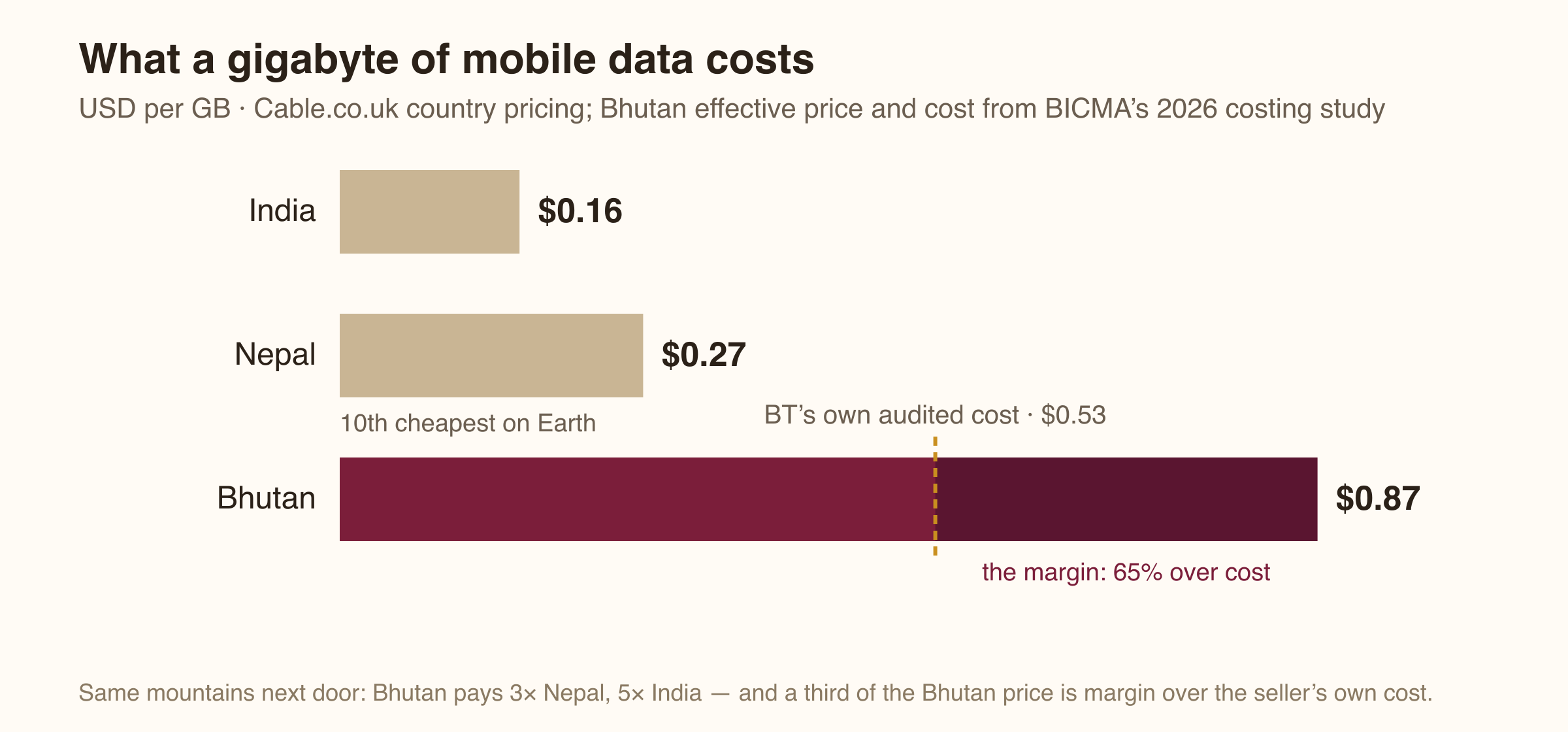
Across the border the comparison is not close. A gigabyte costs about USD 0.27 in Nepal — tenth cheapest on the planet — and USD 0.16 in India. Ours costs three times Nepal's and five times India's. Nepal is poorer than us. Nepal's terrain is our terrain. The difference is that two decades ago Nepal licensed a private competitor with no cousin in the palace and no seat at the cabinet table, and twenty years of two companies fearing each other did what twenty years of pledges here have not.
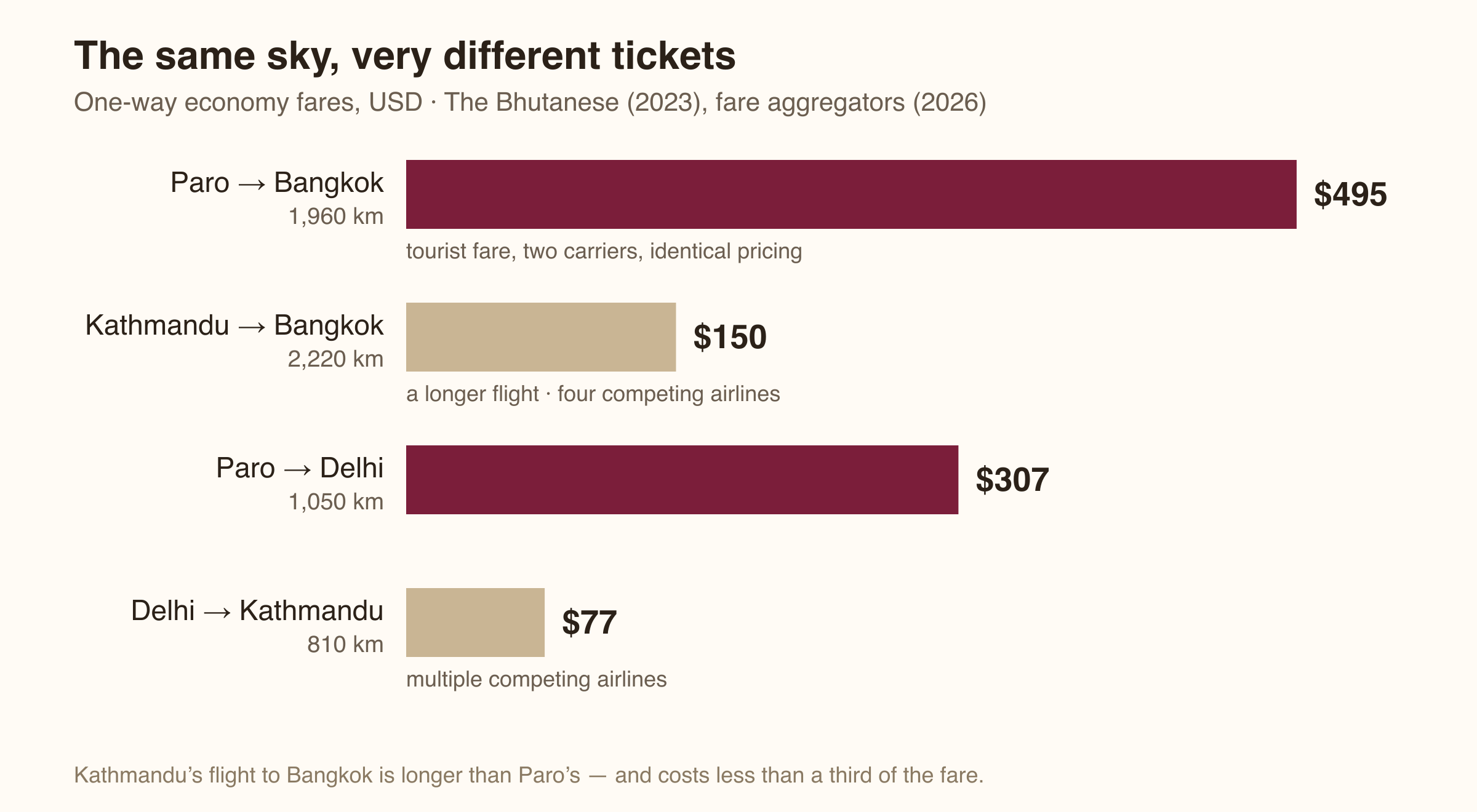
Now the airfare. A tourist flying Paro to Bangkok pays about USD 495 one way. A traveller flying Kathmandu to Bangkok — a longer flight over the same mountains — pays around USD 150, because four airlines fight for the route. Fly Paro to Delhi and the ticket is about Nu 26,740 (~USD 307); Delhi to Kathmandu, a comparable hop, goes for USD 58 to 77. Kuensel itself published the diagnosis this April: between our two carriers "there is no competition" on fares. Of course there isn't. One airline belongs to the state. The other belongs to the country's largest private conglomerate. We will get to who owns that.
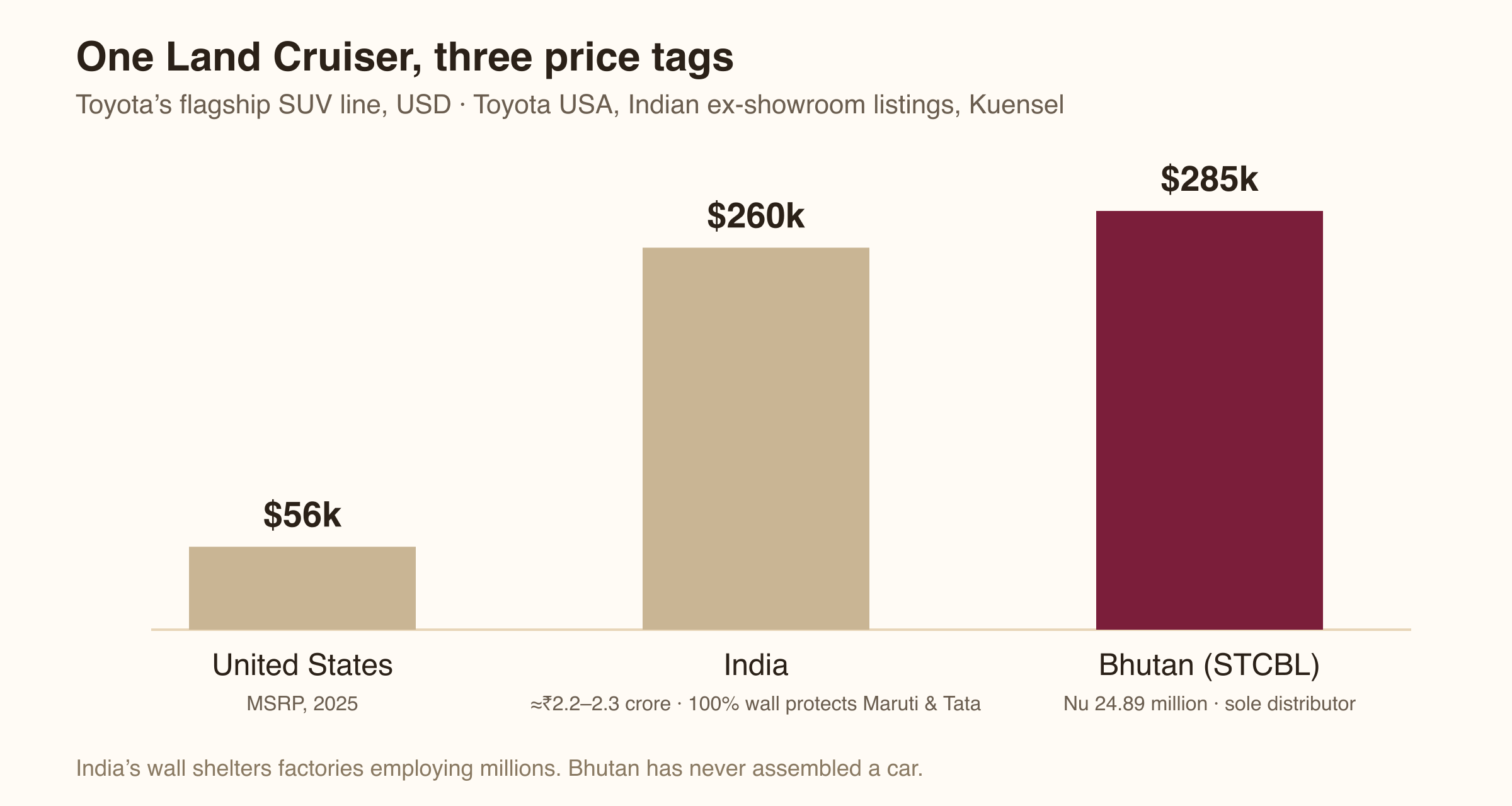
And then the cars. The Land Cruiser that STCBL listed at Nu 24.89 million (~USD 285,000) sells in India — inside the world's most protectionist car market, behind a 100-percent import wall built deliberately to shelter Maruti and Tata — for about USD 260,000. In America it starts at USD 56,450 — roughly a year of median American earnings. At Bhutanese incomes, the STCBL price is several working lifetimes. India at least gets something for its cruelty: the wall protects factories employing millions. Bhutan has never assembled so much as a wing mirror. For decades we taxed vehicles at 45 to 100 percent to protect an auto industry that does not exist — and when the government finally cut those taxes this January, and the price gap with Siliguri still yawned wide enough to send buyers streaming across the border, we all got to see precisely how much of the gap was never tax at all. It was margin. The August notice was the margin defending itself.
Even the fuel in the tank tells the same story. Bhutan buys petroleum from India exempt from Indian taxes, and yet — as The Bhutanese documented this spring — we in all probability pay more at the pump than Indian consumers do, through a pricing chain so opaque that the Department of Trade has begged four years running for an invoice breakdown and never received one. Diesel at the state distributor's pumps stands at Nu 104.38 (~USD 1.20) a litre while the government bleeds Nu 1.16 billion (~USD 13 million) a quarter in subsidies to soften a price nobody here can explain.
A monopoly is only a crime where there is a law
Here is the fact that ties the receipts together, and it belongs in civics textbooks: Bhutan has no competition law.
There is a National Competition Policy, adopted in 2020 — a document that describes, quite eloquently, why monopolies are harmful. There is no Competition Act. No statute defines abuse of dominance, no authority investigates it, no court can punish it. The Constitution itself instructs the state to prevent commercial monopolies; eighteen years into constitutional government, no Parliament has given that instruction teeth. When STCBL closed the border to cheaper Toyotas, when two airlines price identically for years, when a state telecom pockets a 65-percent audited markup — no law is broken, because we never wrote the law.
Ask why not, and the answer stares back from the budget. The IMF put it in numbers this January: state-owned enterprises generate half of all tax revenue in Bhutan, and pay more than three-quarters of all income tax. The government referees these monopolies the way a man referees his own harvest: it is their shareholder, their dividend collector, and their single largest beneficiary. Every ngultrum of that Nu 2.3 billion telecom profit the Prime Minister complains about flows toward his own treasury. A state that eats from the monopoly's margin will scold it, study it, and express deep concern — everything except compete with it. We watched a small perfect rehearsal in December 2024, when the Finance Ministry quietly handed STCBL a no-bid contract to supply every government laptop in the country, and reversed only after private IT firms made noise. The check on the state company turned out to be embarrassment, which is not an institution.
Both sides of the counter
So the state owns one side of every market. Who owns the other?
Forbes answered that question in 2013, in a profile of the man who runs Tashi Group — the conglomerate of forty-odd companies that holds TashiCell, Bhutan Airlines, T-Bank and most of the beer we drink. It noted his family's hereditary rule of the Haa valley, his inherited title, and one more biographical detail, stated flatly: "the king of Bhutan is his cousin." The founder of Tashi Group was a son of the Prime Minister of Bhutan and a brother of the Queen. The Singye Group, another pillar of the private economy, is headed by the younger brother of the four Queen Mothers — the fourth King's brother-in-law, the present King's uncle. When the Chamber of Commerce, the body that exists to fight for open markets, changed presidents in 2012, the gavel passed from the King's cousin to the King's uncle.
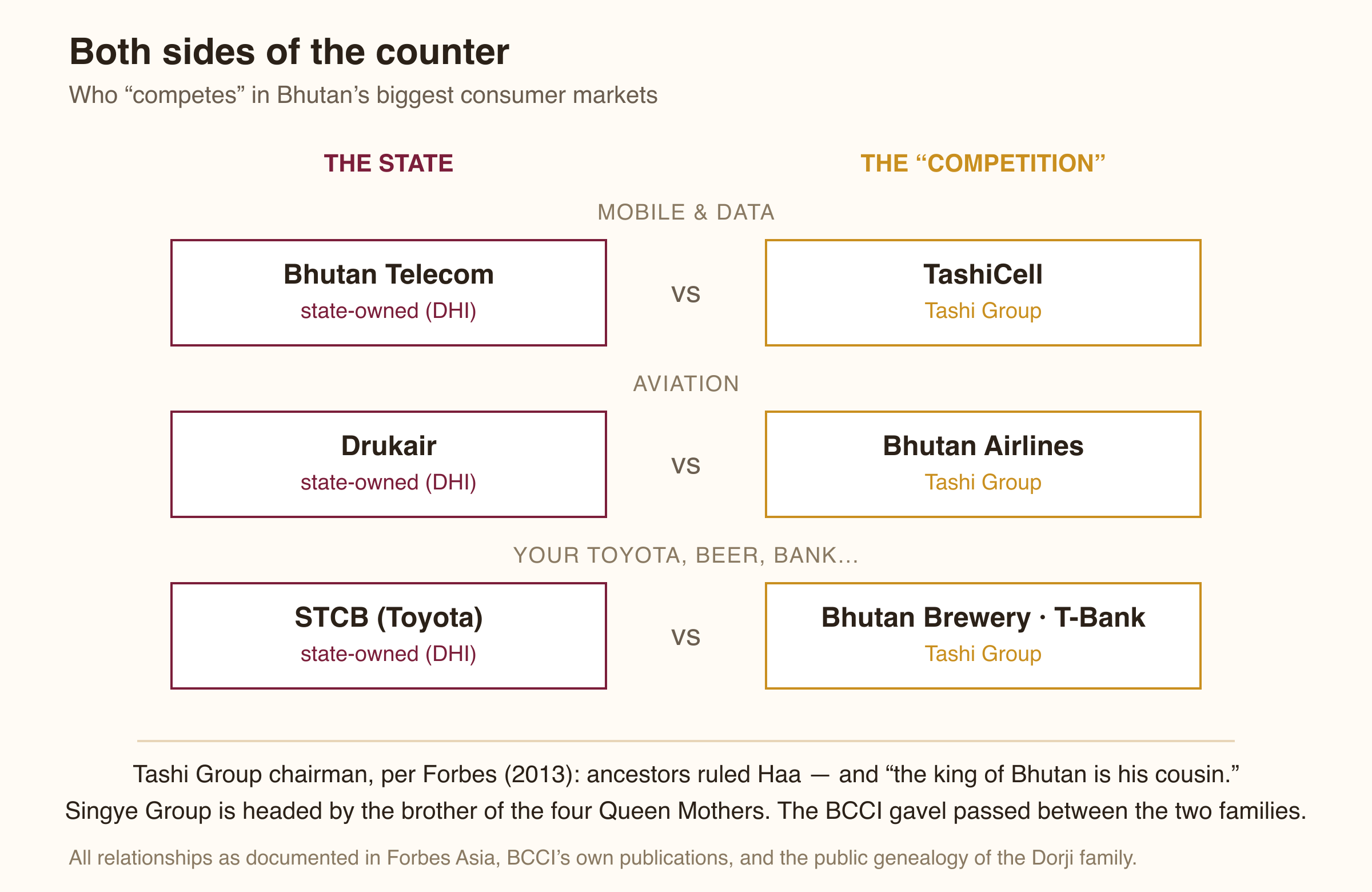
Understand what this means for the word "competition" in Bhutan. The telecom duopoly is the state versus the King's cousins. The aviation duopoly is the state versus the King's cousins. We accuse no one of any crime — every fact above sits in Forbes, in the chamber's own tribute pages, in the public genealogy of the Dorji house. What the facts add up to is quieter and heavier than a crime: a description of a room. And once you have seen the room, the ACC's newest survey finding reads like poetry: Bhutanese no longer worry much about bribery, the Commission reports — what they increasingly fear is favouritism, nepotism, and personal connections. Our people have correctly identified the operating system. In an economy of permissions, nobody needs to sell a favour for cash. The favour is the currency, and some families were issued it at birth.
A country of chits
Which brings us to the humble No Objection Certificate — the paperwork that holds the whole arrangement together.
Count the permissions a Bhutanese life requires. A security clearance to take a government job, renewed annually, as though loyalty expired like insurance. A clearance to stand in an election. A chit from the family, the gewog, the dzongkhag and the Land Commission — a processing chain that can run eighty-two days — to transfer land you already own. A lender's letter to sell your own car. And now, courtesy of STCBL, a No Objection Letter to buy a vehicle from anyone but the monopolist — a letter the monopolist itself has announced it will not issue. The system has achieved a kind of perfection: the referee, the competitor and the permissions desk are the same man, and he is not objecting to your request so much as objecting to your exit.
Some of us know this document more intimately than others. In the 1990s, the No Objection Certificate was the instrument by which this state sorted its own citizens — Lhotshampa families found that without the police's stamp their children could not enrol in school, their graduates could not take government jobs, their names could not appear on a passport. The chit decided who was Bhutanese enough. A hundred thousand people learned that when a state runs on permissions, the withholding of a permission is a weapon that leaves no mark and no record. Nobody claims today's clearance regime is that weapon. But the machine was never dismantled — only repainted — and a machine that once sorted citizens now sorts customers, and the country should ask itself why it keeps the machine at all.
The market has already answered, in its own way: across the border, Indian police are unravelling a trade in Bhutan-routed luxury vehicles moved on forged No Objection Certificates. Wherever permission is the scarcest commodity in the economy, someone will eventually manufacture it. Counterfeit chits are the tribute vice pays to a permission economy.
The tax on moving
Step back from the paperwork and ask the largest question: what do all these prices and permissions actually cost the country?
Bhutan has not one metre of railway. There is no metro, no tram, and outside a thin city bus fleet, no mass transit — there is the road, and what you can put on it. In such a country a vehicle stops being a status symbol and becomes the precondition for participating in the economy. It is how a farmer reaches a market instead of a middleman, how a mother reaches a hospital two valleys away, how a young man in Tsirang takes a job in Gelephu without leaving his family behind. Countries that tax cars punishingly do so to herd people onto trains they built, or to protect factories they own. We built no train and own no factory. We simply taxed movement itself — and then wondered, plan after plan, why domestic trade stays thin, why rural produce rots unsold, why every ambitious youngster concludes that the only mobility on offer is an Australian visa.
The bill for this shows up where bills always show up: at the bank. The transport sector — the taxi drivers and truckers who borrowed at punishing prices to buy the tools of their trade — carries the highest bad-loan ratio in the entire economy, 13 percent. We priced the working man's Bolero like a luxury and financed it like a gamble, and now we act surprised that the gamble sours.
And the government knows all of this — because it wrote the exemption that proves it. Electric vehicles pay no vehicle tax in Bhutan. Think about what that concession admits. It admits the tariff was always a choice. It admits that citizens in cars are good for the country — provided the energy is ours. And on that point the government is right: this is the one country on earth where the patriotic tank of fuel falls from our own sky and runs through our own turbines. Every EV kilometre is a kilometre not paid to an Indian refinery through a pricing formula nobody will show us. Electric vehicles already account for a fifth of our auto imports by value; the ministers just traded their Prados for EVs. The logic is finished. The state subsidises the kilowatt and taxes the kilometre, and it has run out of reasons for doing both.
So finish the thought, and open the EV lane completely: any brand, any channel, any buyer — no sole distributor, no No Objection Letter, no quiet call to showrooms across the border. If the hydropower is as mighty as the speeches say, let the hydropower be the protectionism.
What we want
A Competition Act, this Parliament. Not a policy, not a framework, not a study — a statute, with an authority independent of the ministries that own the monopolies, empowered to investigate the state's own companies first. The Constitution already ordered it. Eighteen years is enough delay.
Name the policy. STCBL stopped lawful cheaper imports "as per the policy." Which policy? Publish it — its text, its author, its date, the minutes of whoever approved it. If it exists, let the public read what was decided in their name. If it cannot be produced, withdraw the notice.
Act on the regulator's own numbers. BICMA has established that data is sold at 65 percent over cost by a company the government owns. The Cabinet does not need another committee; it needs to sign. Every month of delay is a tax on every thumb in the country.
Sunset the chits. Audit every No Objection Certificate, clearance and consent the state demands; each one either justifies its existence in public or dies. Annual security clearances for holding a job should shame a country that calls itself a democracy — and given what this document did to a hundred thousand of us, its burden of proof is not neutral.
Open the EV lane. Zero tax is not enough if the permission desk survives. Free import of electric vehicles through any channel, and let the state's own energy win the argument the state keeps making.
Put the SOEs under lights. The IMF asked for listed-company disclosure for state enterprises; do it, and add every dealership agreement, every exclusive licence, every sole-distributor arrangement to the publication list. The people are the shareholders. Treat them like it.
We are the BhutanWiki Editorial Team. We write the encyclopedia. The encyclopedia is neutral. This is not. This is what we believe.
This year our people learned that five months of sustained anger could turn a tax law around in Parliament — the lever works when pulled. The monopolies are betting that you will not pull it twice.
A country that runs on permission slips will innovate exactly as fast as its permissions desk. Ask instead for a country that has no objection to its own people.
Reply, debate, push back
This is an opinion piece, not a neutral encyclopedia article. We have published our argument; now it is your turn. Agree, disagree, correct us, share your own experience. The discussion page is for you.