Gelephu International Airport
From BhutanWiki, the people's encyclopedia of Bhutan · places · Verified
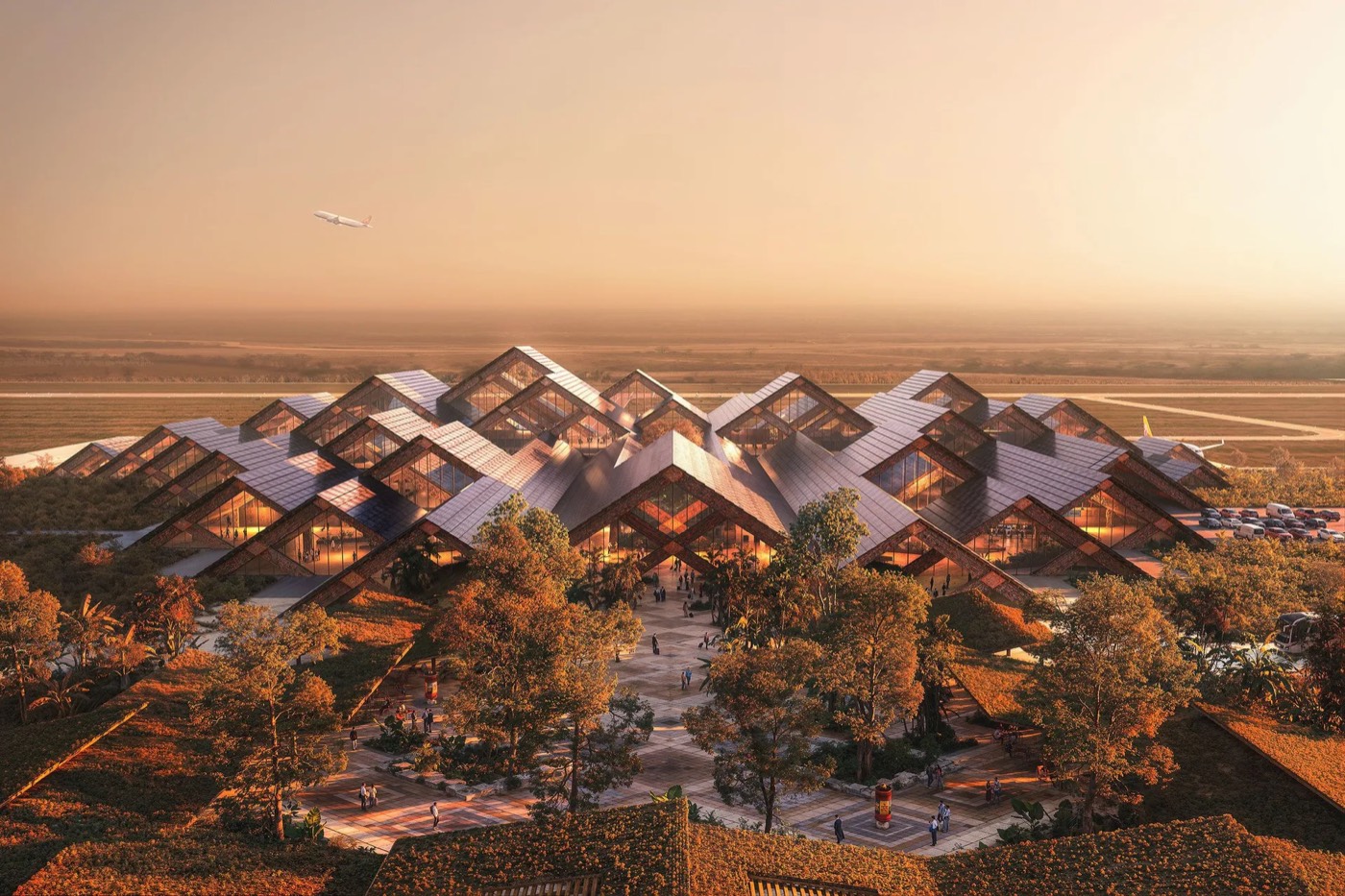
Gelephu International Airport is a planned airport under construction near Gelephu in southern Bhutan. When completed it will be the country's second international airport after Paro International Airport, and the principal gateway to the Gelephu Mindfulness City (GMC), the special administrative region being developed in Sarpang Dzongkhag.[1]
The terminal was designed by the Danish architecture practice Bjarke Ingels Group (BIG) with the aviation consultancy NACO, and forms part of the wider BIG-led GMC master plan. Its design, made public in March 2025, is built around a carved and painted mass-timber frame that from a distance reads as a stylised mountain range. The building is intended to make air travel calmer rather than more stressful, drawing on Bhutan's stated emphasis on psychological well-being and Gross National Happiness.[2]
Ground was broken on 8 July 2025 at a ceremony attended by King Jigme Khesar Namgyel Wangchuck and Queen Jetsun Pema, with the two young princes present. The airport is scheduled to open in 2029.[3]
Background
An airstrip has existed at Gelephu since the 2010s. The existing Gelephu Airport (IATA: GLU) sits about 3 kilometres from the town in Sarpang and has a 1,500-metre asphalt runway. It was inaugurated in 2012 and came into regular use later in the decade, operated by Drukair as one of Bhutan's small set of domestic airports. In December 2025 Drukair began scheduled flights from Gelephu to Kolkata, its first international service.[4]
The new international airport is a separate, far larger facility on a fresh site rather than an expansion of the existing strip. The government announced the project in 2023 as part of the proposed Gelephu Special Administrative Region. A groundbreaking was first marked on 23 December 2023, with the major royal ceremony following on 8 July 2025. The development occupies roughly four square kilometres across the Paitha (Payeha) River near the Bhutan–India border, and required the relocation of landowners in the Samtenling area whose plots fell on the runway alignment.[5]
Design
The terminal covers about 68,000 square metres. Its defining element is a modular structure of mass-timber frames that step up and down like a mountain silhouette. BIG named Bjarke Ingels, Frederik Lyng and Giulia Frittoli as design partners in charge, working with NACO, Changi Airport Planners and Engineers, the Thai developer MQDC and the cost consultancy WT Partnership.[6]
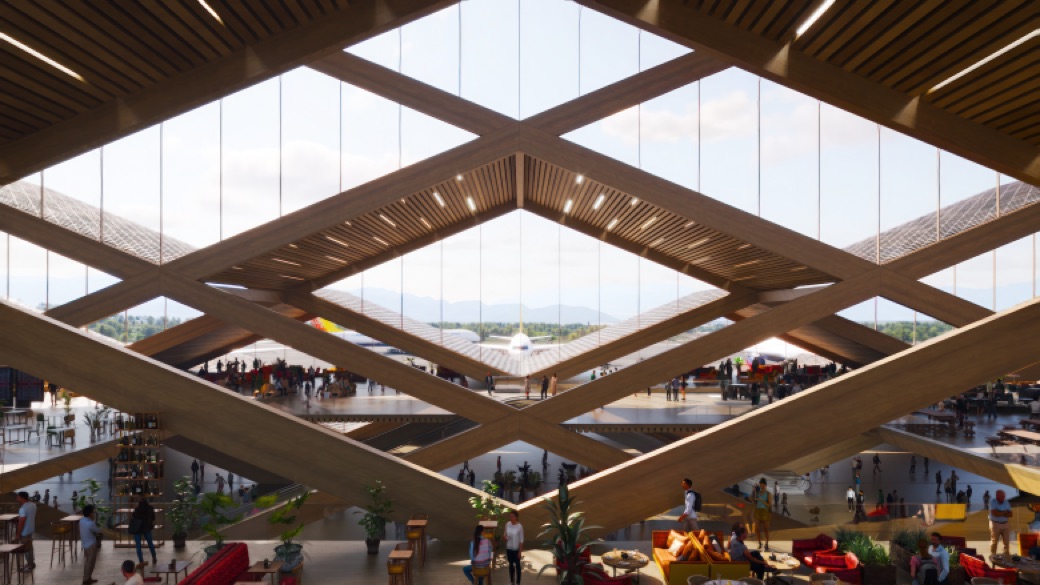
Internally the terminal is organised around a planted courtyard the architects call the "Forest Spine," which runs the length of the building and divides it into two halves — domestic flights to the west and international flights to the east. The forest cover of the surrounding highlands is meant to flow from the arrival plaza, through immigration, security and baggage halls, and out to the tarmac, with tropical trees giving shade and a treetop walkway over the green spine. Triple-height entry volumes, floor-to-ceiling glazing and skylights keep the interior naturally lit.[1]
Mindfulness concept
The airport is presented as part of the "mindfulness" theme of the surrounding city. Rather than treating the terminal purely as a processing machine, the design sets aside indoor and outdoor lounges for yoga, meditation and gong baths, intended to let travellers slow down before or after a flight. The architects describe this as an attempt to translate Bhutan's emphasis on happiness and mental well-being into the experience of arriving in or leaving the country.[7]
Timber and craft
The frame uses a diagrid of sustainably sourced glued-laminated (glulam) timber. The painted timber draws on the Bhutanese kachen, the large carved wooden load-bearing pillar found in dzongs and monasteries, which is often decorated with dragons. Local artisans are to carve and colour the timber members in traditional craft, with three styles of dragon representing Bhutan's past, present and future. Because the diagrid is modular, it is designed to be taken apart and rebuilt as the airport expands. The roof carries photovoltaic panels, in keeping with Bhutan's position as a carbon-negative country.[8] The design was shown at the 2025 Venice Architecture Biennale and named Future Project of the Year at the World Architecture Festival in 2025.[6]
Capacity and timeline
The airport is planned around a 3,000-metre runway built to CAT I Code 4E standards, initially able to handle narrow-body aircraft such as the Airbus A321 and Boeing 737, with scope for wide-body jets later. It is sized for about 123 flights a day, with roughly 1.3 million passengers a year projected by 2040, rising to around 5.5 million by 2065.[7]
Earthworks to divert the Paitha River began after the July 2025 groundbreaking, with the main runway and terminal works set to follow. Construction has been described as a roughly four-year programme leading to an inauguration in 2029. As with much of the Gelephu Mindfulness City scheme, the dates and capacity figures come from the project's own publicity and remain projections rather than completed facts.[3]
Relationship to Gelephu Mindfulness City
The airport is the first large piece of infrastructure for the Gelephu Mindfulness City, a special administrative region announced by the King in 2023 and given a royal charter in 2024. The Gelephu Mindfulness City Authority is the body overseeing the airport's delivery. Officials have framed the airport as the project's front door, intended to connect the planned city to international markets and to draw tourism and investment to southern Bhutan.[9]
References
- Wood carvings to embellish Gelephu International Airport by BIG — Dezeen
- Bjarke Ingels Group plans ornamental airport in Bhutan with intricate woodcarvings — Designboom
- From Vision to Runway: Gelephu International Airport Breaks Ground — Daily Bhutan
- Gelephu Airport — Wikipedia
- Relocation underway for Gelephu international airport project — Kuensel
- Gelephu International Airport — BIG (Archello)
- Gelephu International Airport: BIG's Take on Sustainable Aviation and Bhutanese Heritage — Parametric Architecture
- Designed by BIG, Bhutan's Gelephu International Airport Blends Timber and Tradition — Architect Magazine
- Bjarke Ingels Group designs modular timber airport for Bhutan — Global Construction Review
Related articles
Know something about this topic? Edit this article or . Anonymous contributions welcome — no account required.