Traditional Games of Bhutan
From BhutanWiki, the people's encyclopedia of Bhutan · culture · Verified
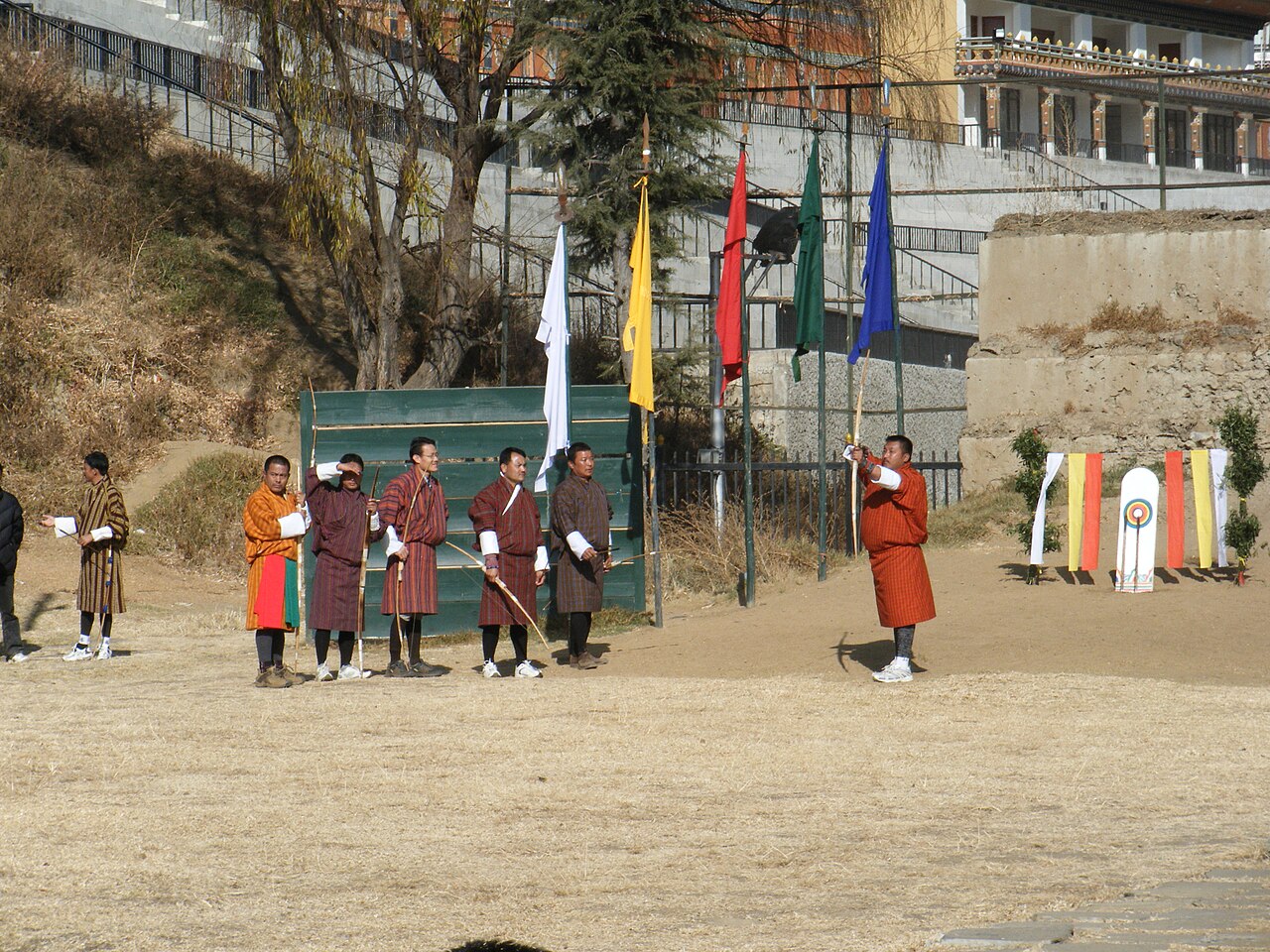

Bhutan's traditional outdoor games are inseparable from the country's festival culture. Played in open fields adjacent to tshechus and other community gatherings, they combine physical competition with communal celebration — singing, dancing, and the sharing of food and ara are woven into the events rather than kept separate. The games trace their origins to highland pastoralist communities, where hurling heavy stones and throwing implements were practical physical skills. Today they represent a living sporting heritage performed alongside, and in the spirit of, Bhutan's national sport of archery.
Khuru
Khuru is one of Bhutan's most popular traditional games and the one most regularly played as a companion to archery tournaments. Players throw heavy wooden darts — each tipped with a ten-centimetre iron nail — at a paperback-sized target placed ten to twenty metres away. Teams typically consist of eight to twelve players, and one point is scored each time a player strikes the target. Like archery matches, khuru competitions are accompanied by songs and dances: when a player scores, teammates and supporters sing and clap in a burst of celebration that punctuates the competition.
The weight and design of the dart requires considerable technique. Unlike a light javelin or throwing knife, the khuru dart must be released with enough rotational force to embed its nail tip in the target board, which demands a particular wrist action developed through practice. Skilled players are respected in their communities, and inter-village khuru matches are keenly contested.
Digor
Digor is the game most frequently compared to a combination of shot put, horseshoes, and pétanque. Players hurl pairs of spherical flat stones at two small target pegs fixed in the ground approximately twenty metres apart. The objective is both to hit the pegs directly and to land stones as close to them as possible. Digor can be played one-on-one or in teams of up to seven, and scoring reflects a combination of direct hits and proximity — much like boules or bocce.
The stones used in digor are traditionally shaped from river granite, smoothed over generations of use. Sets are often kept as family or village property, passed down alongside other communal equipment. The game is played on relatively flat ground, making open paddy field margins and dzong courtyards typical venues during dry-season festivals.
Soksom and Pundo
Soksom most closely resembles the javelin throw but with an important distinction from the Olympic event: the objective is not maximum distance but accuracy. Players throw a javelin-like implement at a target fixed twenty metres away. Precision rather than power determines the winner, making it a more technically demanding variant of throwing games.
Pundo is the Bhutanese equivalent of shot put. A stone weighing over one kilogram is thrown as far as possible, with the throwing movement originating from the shoulder and the stone held flat in the palm — a technique that differs somewhat from the standard shot put grip. Pundo is often the most straightforwardly athletic of the traditional games, rewarding strength and coordination in roughly equal measure.
Cultural Context and Survival
All four games are played most intensively during tshechus and other seasonal festivals, when communities gather over several days and the fields around the dzong or lhakhang become informal sports grounds. The festive atmosphere is part of the point: competition and celebration are not separated in Bhutanese sporting culture. Observers are as much part of the event as players, and the songs sung to celebrate a good throw are as traditional as the throw itself.
Traditional games have faced pressure from the growth of football, basketball, and other international sports, particularly among urban youth. In 2009, reports noted concern that these games were gradually losing younger practitioners. However, efforts by the Bhutan Olympic Committee and district administrations to incorporate traditional sports into school sports days and national festivals have helped maintain their visibility. Khuru in particular remains extremely popular in rural areas and continues to draw large crowds at major tshechus.
See also
- Traditional Board Games of Bhutan
- Traditional Bhutanese House Design
- Drungtsho (Traditional Physician)
- Traditional Sports of Bhutan
References
Related articles
Know something about this topic? Edit this article or . Anonymous contributions welcome — no account required.